Introduction
Structural steel fabricators are navigating three converging pressures at once. Project timelines keep compressing, skilled labor is harder to find and more expensive to retain, and structural tolerances on commercial and industrial projects leave less margin for field corrections than they used to.
These pressures explain why laser cutting automation has moved from a large-shop luxury to a practical operational consideration for a much broader range of fabricators. Most fabricators today already know automated laser cutting delivers results. The real gap is understanding what those results actually look like day-to-day.
This article focuses on operational reality: what laser cutting automation delivers on gussets, connection plates, and high-volume structural runs — measured in dimensional precision, throughput, and cost outcomes that show up in KPIs fabricators already track.
Key Takeaways
- Fiber laser systems deliver tighter tolerances on structural steel than plasma or oxy-fuel cutting
- Automated material handling extends machine run hours far beyond what manual operation allows
- Tighter dimensional accuracy reduces rework frequency and protects downstream welding and assembly schedules
- Labor requirements per ton processed drop significantly when loading, monitoring, and sorting are automated
- Building CNC process discipline on a plasma table directly prepares a shop for successful laser automation
What Is Laser Cutting Automation for Structural Steel?
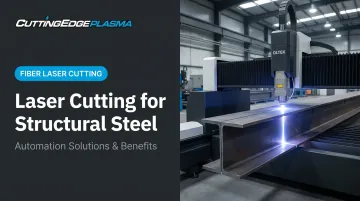
Laser cutting automation for structural steel uses high-powered fiber laser systems — driven by CNC motion control — to cut plates, gussets, brackets, and connection elements with minimal operator intervention. Fully automated configurations add material loading, part sorting, and nesting optimization, turning what was once a multi-person manual process into a high-throughput, largely unattended workflow.
What the System Actually Handles
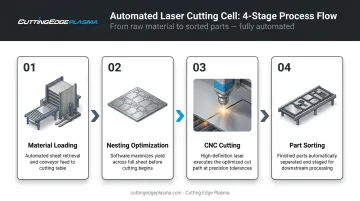
A complete automated laser cutting cell typically manages:
- Material loading — sheet feeders or tower storage systems deliver raw stock to the cutting area without manual positioning
- Nesting optimization — software arranges parts on each sheet to minimize waste before cutting begins
- Cutting — programmed cut paths run with CNC-controlled motion and real-time height sensing, requiring no operator adjustment mid-cycle
- Part sorting — automated unloading separates finished parts from skeleton scrap
The result is consistent part quality, faster turnarounds, and a measurable drop in labor hours per ton of steel processed.
Key Advantages of Laser Cutting Automation for Structural Steel
The advantages below track operational outcomes structural steel fabricators measure directly: part accuracy, throughput per shift, rework rates, labor cost per component, and delivery time. Results scale with consistent application across full production runs, not just select jobs.
Tighter Dimensional Accuracy and Superior Cut Quality
Laser cutting automation delivers positional accuracy and narrow kerf widths that are substantially tighter than plasma cutting. For structural steel components — connection plates, flange cuts, bolt-hole patterns — this matters because field fit-up depends on dimensional consistency across every part in a run, not just representative samples.
CNC motion control and real-time height sensing work together to maintain consistent focal distance across the cutting surface. This prevents the edge variation that accumulates in manual or semi-manual plasma operations, particularly on thicker structural steel where standoff inconsistency has the largest effect on cut quality.
Why this translates to real cost savings:
- Tighter tolerances directly reduce rework frequency. According to IPG Photonics, fiber lasers achieve measurably smaller heat-affected zones (HAZ) than plasma cutting — which preserves material properties adjacent to the cut on load-bearing components
- High-quality laser-cut edges often eliminate the need for secondary grinding before welding, removing an entire step from the fabrication sequence
- When structural components arrive on-site dimensionally accurate, downstream welding and assembly timelines hold — field adjustments don't cascade into schedule delays
KPIs directly impacted: First-pass acceptance rate, rework labor hours per project, secondary finishing time, field fit-up success rate
When this matters most: High-complexity structural assemblies with precise connection requirements, tight bolt-pattern tolerances, and fabricators competing on quality differentiation
Higher Production Speed and Extended Throughput
Modern fiber laser systems cut thin to medium structural steel significantly faster than conventional plasma cutting. As Hypertherm notes, this speed advantage is most pronounced on material thicknesses where laser cutting operates well within its power range — and high-power sources (some systems exceed 20kW) extend that advantage further into heavier plate.
The larger throughput gain, though, comes from what happens around the cut:
- Automated loading eliminates idle time between sheets
- Nesting optimization runs continuously, removing manual layout and marking from the pre-cut sequence
- A single monitored system can sustain cutting cycles through extended shifts that would otherwise require multiple operators or remain idle
Fabricators running automated laser systems report significantly extended beam-on time per shift compared to manual loading. Some configurations support lights-out operation through overnight windows.
Why this translates to competitive positioning:
- Faster setup per job (CNC programming vs. manual layout) means the shop responds more quickly to changing order volumes
- More parts processed per shift without adding floor space or headcount
- Fabricators who turn around cut components faster can take on more projects with the same physical footprint
KPIs directly impacted: Tons processed per shift, machine utilization rate, order turnaround time, capacity per square foot of shop floor
When this matters most: High-volume runs of repetitive structural components (gussets, stiffener plates, bracket families), two-shift or three-shift operations, and shops under deadline pressure on commercial construction projects
Labor Efficiency and Measurable ROI
Laser cutting automation restructures labor requirements. Where multiple operators once handled loading, monitoring, and part management, one trained technician can oversee a system producing significantly greater output. That shift changes the underlying labor model, not just the headcount.
The ROI calculation draws from several variables:
| Variable | Effect |
|---|---|
| Reduced operator hours per ton cut | Lower labor cost per component |
| Optimized nesting | Less material waste, lower scrap percentage |
| Eliminated secondary finishing | Fewer post-cut labor hours |
| Extended machine run time | More output per capital dollar invested |
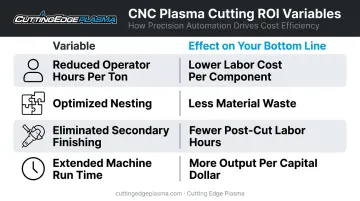
According to industry analysis, payback periods for laser cutting automation vary based on production volume, shift utilization, and local labor costs — but fabricators running the system at high utilization across multiple shifts see the economics shorten considerably. Nesting software contributes directly: optimized layouts reduce material waste, and those savings accumulate across every sheet processed.
KPIs directly impacted: Labor cost per component, material utilization rate, scrap percentage, payback period, cost per ton processed
What drives the strongest returns: Fabricators running consistent structural steel volumes, operations constrained by skilled operator availability, and shops where material cost is a significant margin driver
What Happens When Laser Cutting Automation Is Skipped
Manual and semi-manual cutting methods carry hidden costs that grow harder to ignore as project volumes and tolerances tighten:
- Inconsistent part dimensions create downstream welding problems and field fit-up delays that ripple through every structural assembly
- Headcount scales with volume instead of output — more work means more labor cost, not more efficiency from existing staff
- Shops struggle to bid competitively on projects with tight tolerances or fast-turn delivery when the cutting process is the bottleneck
- Dimensional errors surface after cutting rather than being prevented, forcing reactive inspection cycles instead of controlled, repeatable results
For a busy fabrication shop, these aren't occasional setbacks — they're a consistent drag on margin that shows up in every job, whether or not the accounting captures it.
How to Get the Most Value from Laser Cutting Automation
Laser cutting automation performs best when applied systematically. The fabricators who see the strongest returns treat it as an ongoing practice, not a one-time setup:
- Establish consistent nesting strategies — apply the same optimization logic to every run, not just large jobs. Material savings from nesting compound over time
- Review cutting parameters regularly — compare actual part quality against programmed parameters and adjust. Drift in cut quality is easiest to correct early
- Build clear communication between programmers and operators — the person running the machine needs to communicate what's happening on the floor; the programmer needs to act on it. This feedback loop drives continuous improvement
- Track the right KPIs — material utilization rate, first-pass acceptance rate, and machine uptime give you the data to improve rather than just monitor
For smaller shops, lower-volume operations, or those processing structural steel alongside other work, building this process discipline on a CNC plasma cutting system is a practical starting point. Cutting Edge Plasma's iPlasma XTREME tables include integrated torch height control, THC Anti-Dive for accurate holes and corners, and MyPlasma CNC motion control software. These are the same operational habits — parameter management, nesting, CNC workflow — that drive laser automation success at scale.
Starting on a plasma table that demands this discipline prepares a shop for the transition when volume justifies the investment in laser automation.
Conclusion
Laser cutting automation for structural steel is an operational control story. Fabricators who adopt it gain tighter tolerances, more predictable throughput, and a labor cost structure that scales without proportional headcount growth. Apply those gains consistently, and the compounding effect shows up in lower scrap rates, less rework, and the capacity to bid on higher-margin structural work.
Building that discipline starts with the right equipment decision. Whether that's a plasma table to establish CNC workflow or a fiber laser system for precision-critical structural cuts, fabricators who treat automated cutting as an ongoing practice — refining feeds, nesting strategies, and material handling over time — see returns that a one-time capital purchase alone never delivers.
Frequently Asked Questions
What type of laser is best for cutting through metal?
Fiber lasers are the dominant choice for cutting structural steel and other metals. They offer high electrical efficiency, strong performance on thick sections, and direct compatibility with CNC automation systems. Power ranges for structural steel applications typically run from 3kW for lighter plate up to 20kW and beyond for heavier sections.
What software is best for laser cutting design?
CAD/CAM software with integrated nesting capabilities is the standard for structural steel fabrication. Tools that connect directly to Tekla models or export DXF files compatible with CNC controllers — SigmaNEST is a common example — close the gap between design and the cutting floor efficiently.
How does laser cutting compare to plasma cutting for structural steel?
Laser cutting offers tighter dimensional accuracy, narrower kerf, and a smaller heat-affected zone than plasma cutting. Plasma cutting remains cost-effective for thicker plate sections or applications where laser-level precision isn't required on every component — the right choice depends on the tolerance requirements and production volume of the specific application.
What thickness of structural steel can laser cutting handle?
Modern fiber laser systems can cut mild steel up to approximately 50mm, depending on laser power. Most structural plate work falls well within the productive range of mid-to-high power fiber lasers, where both cut quality and throughput are at their best.
Is laser cutting automation worth the investment for smaller fabrication shops?
The economics are most favorable when the system runs at high utilization across multiple shifts. Smaller or lower-volume shops often find a better entry point through CNC plasma cutting or phased automation — building the process discipline and production volume that make a full laser automation investment financially compelling before committing to the capital expenditure.
How accurate is laser cutting for structural steel components?
Automated fiber laser systems on structural steel typically achieve positional accuracy within ±0.1mm or better. This level of precision matters directly for connection plates, bolt-hole patterns, and weld prep features — components where dimensional errors in fabrication become fit-up problems in the field.