Key Takeaways
- Fiber laser cutting speed for mild steel ranges from ~24 IPM on 20mm plate to 1,300+ IPM on 1mm sheet, depending on power and assist gas
- Oxygen assist gas significantly increases mild steel cutting speed through an exothermic chemical reaction
- Manufacturer speed charts are starting points — real-world throughput is lower due to pierce time, acceleration, and nesting
- Plasma cutting can match or exceed fiber laser speeds on thick plate (12mm+) — often at significantly lower machine cost
- Validate settings with test cuts and optimize pierce time and lead-ins — raw speed alone doesn't determine throughput
Fiber Laser Cutting Speed for Mild Steel: What to Expect
Fiber laser cutting speed is measured in inches per minute (IPM) or meters per minute (m/min). The range is dramatic: a 1mm sheet can run at over 1,000 IPM on a mid-range machine; 20mm plate on the same machine might crawl along at 16–24 IPM.
According to Raycus, actual cutting speeds fluctuate based on oxygen purity, plate quality, shielding gas, nozzle size, and other real-world conditions — so published parameter tables are better treated as calibrated starting points than guaranteed output rates.
Rated Speed vs. Real-World Throughput
The gap between a machine's peak commanded speed and actual shop throughput is wider than most buyers expect. The Fabricator reports that a 12kW system cutting 18-gauge carbon steel can be commanded to 2,000 IPM, but the motion system itself becomes the limiting factor. And that's before accounting for:
- Pierce time — a 3kW laser takes several seconds to pierce 0.25" material; 9–12kW systems can pierce almost instantaneously
- Lead-in paths — every cut starts with a lead-in that adds non-productive travel
- Acceleration and deceleration — the machine slows through corners regardless of commanded speed
- Nesting efficiency — rapid traversal between parts eats time that doesn't show up in rated speed specs
In practice, a machine rated at 2,000 IPM may deliver effective throughput closer to 400–600 IPM once pierce cycles, acceleration ramps, and traversal moves are factored in — which is why cut-time estimates based on peak speed alone tend to miss production reality by a wide margin.
Fiber Laser Cutting Speed for Mild Steel by Power Level
The table below uses oxygen assist gas as the baseline for 3mm–20mm thicknesses, sourced from Raycus CW Fiber Laser cutting parameters. For 1mm material, Raycus specifies nitrogen or air (not oxygen) for thin carbon steel — those values are noted separately.
Reference Speed Table (Oxygen Assist Gas, Carbon Steel)
| Power | 3mm O₂ | 6mm O₂ | 10mm O₂ | 12mm O₂ | 20mm O₂ |
|---|---|---|---|---|---|
| 1kW | 3.0 m/min / 118 IPM | 1.5 m/min / 59 IPM | 0.8 m/min / 31 IPM | N/A | N/A |
| 1.5kW | 3.6 m/min / 142 IPM | 1.4 m/min / 55 IPM | 1.0 m/min / 39 IPM | 0.8 m/min / 31 IPM | N/A |
| 2kW | 4.2 m/min / 165 IPM | 1.8 m/min / 71 IPM | 1.1 m/min / 43 IPM | 0.9 m/min / 35 IPM | 0.4 m/min / 16 IPM |
| 3kW | 4.0 m/min / 157 IPM | 2.7 m/min / 106 IPM | 1.5 m/min / 59 IPM | 1.0 m/min / 39 IPM | 0.6 m/min / 24 IPM |
| 6kW | 3.6–4.2 m/min / 142–165 IPM | 2.7–3.2 m/min / 106–126 IPM | 2.0–2.3 m/min / 79–91 IPM | 1.9–2.1 m/min / 75–83 IPM | 0.6–0.7 m/min / 24–28 IPM |
| 12kW | N/A (N₂/Air) | N/A (N₂/Air) | 2.3 m/min / 91 IPM | 2.0 m/min / 79 IPM | 1.4 m/min / 55 IPM |
Source: Raycus CW Fiber Laser 500–20000W Cutting Parameters
For 1mm thin sheet (N₂/Air assist): Raycus documents significantly faster speeds — 2kW hits ~984 IPM, 3kW reaches ~1,378 IPM, and 6kW climbs to ~1,772 IPM. These use nitrogen or air, not oxygen.
What Each Power Tier Does Well
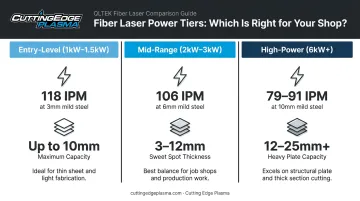
- Entry-level (1kW–1.5kW): Handles mild steel up to 6–10mm. At 3mm, a 1kW system delivers 118 IPM with oxygen — practical for light fabrication and hobbyist shops running thin sheet consistently.
- Mid-range (2kW–3kW): The speed gain is most visible at 6mm and above. A 3kW machine runs 106 IPM at 6mm versus 59 IPM at 1kW, nearly double. This range covers 3mm–12mm with production efficiency, making it the most common choice for small fabrication shops and job shops.
- High-power (6kW+): Speed advantages grow with thickness. At 10mm, 6kW delivers 79–91 IPM versus 59 IPM at 3kW and 31 IPM at 1kW. On thin sheet, however, gains plateau — 6kW and 3kW oxygen results at 3mm are nearly identical. The real return on high-power investment is on 12mm–25mm+ plate, not on thin gauges where lower-wattage machines already perform well.
Factors That Determine Fiber Laser Cutting Speed on Mild Steel
Laser Power and Beam Quality
More wattage means more energy delivered to the cut zone, which directly enables faster cutting. TRUMPF confirms that higher power allows faster cutting while speed drops as thickness increases.
Beam quality also matters. A tighter focal spot concentrates energy into a smaller area, achieving higher intensity without requiring more raw power. IPG Photonics explains that spot size defines where energy is concentrated — smaller spots raise energy density, which supports faster, cleaner cuts on thin material. Thicker material needs a larger spot to expel molten metal from the kerf.
Assist Gas Type and Pressure
For mild steel, oxygen is the preferred assist gas — its role is primarily chemical. TRUMPF notes that oxygen blown into the kerf at up to 6 bar burns and oxidizes the metal melt, with the reaction energy actively supporting the laser beam. Bodor confirms this exothermic effect enhances both penetration and melt removal on carbon steel.
The tradeoff is real, though. IPG notes that pure oxygen produces lower cut rates and edge quality compared to mixed assist gas at higher power-to-thickness ratios. Raycus specifies nitrogen or air for very thin carbon steel (1–2mm), where oxygen can cause excess dross. Gas choice is thickness-dependent, not universal.
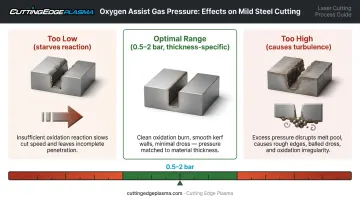
Pressure matters too. Raycus data shows oxygen pressures ranging from 0.5–2 bar depending on thickness:
- Too low: limits the exothermic assist, reducing cut speed and penetration
- Too high: creates turbulence and rough, inconsistent edges
- Optimal range: thickness-specific — verify against your machine's cut chart
Material Thickness and Surface Condition
The inverse relationship between thickness and speed is straightforward: thicker material requires more energy per unit length, so the laser must slow down to achieve full penetration.
Surface condition complicates this further. Mazak Optonics notes that thick mild steel cut with oxygen on fiber lasers is affected by plate composition, rust, scale, and heat buildup — all of which alter required parameters and can compromise edge quality. A rusty or mill-scaled surface scatters the beam and demands speed adjustments that clean plate doesn't.
Focus Position and Nozzle Setup
Focal point position must be dialed in for each thickness. Bodor's data shows that negative focus (focus point below the surface) suits medium and thin plate by increasing energy density, while positive focus is used on thick plate to widen the spot and stabilize the oxidation reaction. Raycus cut charts reflect this — oxygen rows for thicker material commonly use positive focus values of +3 to +8.
Nozzle standoff and diameter directly affect gas flow around the kerf. Key setup parameters from Raycus include:
- Cutting height: approximately 0.8mm for oxygen cutting rows
- Standoff deviation: any deviation disrupts gas coverage and degrades cut quality
- Nozzle diameter: sized to match thickness and gas pressure for consistent flow
How to Optimize Fiber Laser Speed When Cutting Mild Steel
Getting the most from your fiber laser on mild steel comes down to a few practical levers. Each one affects cut quality, throughput, or both — and most are adjustable without new hardware:
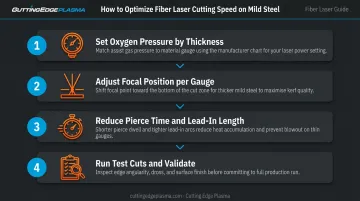
Set oxygen pressure correctly for each thickness. The Raycus data shows most 3–20mm oxygen cuts run at 0.5–0.6 bar, with thinner material sometimes requiring higher pressure (up to 2 bar at 2mm). Start at the published value and test from there — too low starves the exothermic reaction, too high creates dross and blowout.
Adjust focal position by thickness, not once per session. Running a fixed focus setting across different thicknesses costs speed and quality. Use the manufacturer's recommended focus offset for each material, and verify it when switching between gauges.
Reduce pierce time and lead-in lengths. On high-power systems, pierce time is often where production time disappears. Flying pierces on thin sheet, shorter lead-ins, and tighter nesting all recover throughput without adjusting cut speed itself.
Run test cuts, not guesses. Manufacturer speed charts are starting points. Cut scrap at incrementally higher speeds and examine the underside for dross, check edge angle for squareness, and look for slag lines. The fastest usable speed is the one that still produces a clean, dross-free edge. That number is specific to your machine, your gas supply, and your material.
Fiber Laser vs. Plasma Cutting Speed for Mild Steel
The "fiber laser is always faster" assumption breaks down quickly when thickness enters the equation.
On thin mild steel under 6mm, fiber lasers generally have a speed and precision advantage — narrower kerfs (roughly 0.2–0.4mm with oxygen, per Hypertherm data) and tighter tolerances that plasma can't match. But the picture shifts significantly as plate thickness increases.
Hypertherm reports that at 10mm, a 170A X-Definition plasma process can deliver high-quality cuts at twice the speed of a 4kW fiber laser using oxygen. Above 16mm, plasma pulls ahead on multiple fronts:
- Faster cut speeds at thickness
- Lower initial capital investment
- Lower direct operating cost per cut
- More forgiving on imperfect or mill-scale-covered plate
IPG offers a counterpoint for very high-power systems: at 60kW fiber power, mild steel at 40mm can be cut roughly 2.5x faster than a 460A plasma setup. At that power level and price point, however, few fabrication shops are in the market — 60kW fiber systems are industrial-scale equipment with price tags to match.
Those speed differences connect directly to kerf width, which affects both part precision and how tightly you can nest parts on a sheet:
| Metric | Fiber Laser | Plasma |
|---|---|---|
| Kerf width | 0.2–0.4mm | ~1.5mm (thin) to ~5mm (300A / 25mm plate) |
| Speed crossover | Under 6mm: laser faster | 10mm+: plasma faster |
| Capital cost (25mm capable) | ~$525,000–$700,000+ | ~$175,000–$225,000 |
| Best fit | Thin sheet, tight tolerances | Thicker plate, high-volume cutting |
That capital cost gap is significant. Hypertherm estimates an XPR300 plasma system on a quality cutting table capable of cutting 25mm at over 75 IPM runs roughly $175,000–$225,000. A comparable fiber laser runs 3–4x more.
For shops cutting thicker mild steel plate, that math matters. The iPlasma XTREME series from Cutting Edge Plasma, paired with a Hypertherm Powermax 85 or 125, handles mild steel up to 1–1.25 inches — covering the thickness range where plasma already holds the speed advantage — at a fraction of the fiber laser entry cost.
Frequently Asked Questions
How fast can a laser cut steel?
Speed depends heavily on thickness and power. At 1mm using nitrogen or air assist, a 3kW system can reach approximately 1,378 IPM. At 12mm with oxygen, the same machine runs around 39 IPM. Thicker plate (20mm+) at 3kW drops to 16–24 IPM.
How thick of steel can a 1000W laser cut?
A 1kW fiber laser can cut mild steel through approximately 10mm with oxygen assist, based on Raycus parameter data (0.8 m/min / 31 IPM at that thickness). Edge quality and speed degrade significantly approaching that limit. For production work, 1–6mm is the practical sweet spot.
How thick will a 1500 watt fiber laser cut?
Raycus parameter data shows a 1.5kW fiber laser cutting mild steel at 12mm (31 IPM), 14mm (25 IPM), and 16mm (20 IPM) with oxygen. For production work, 12–15mm is the practical range — beyond that, speeds drop and parameter sensitivity increases sharply.
How thick will a 3000W laser cut?
According to Raycus data, a 3kW fiber laser cuts 20mm mild steel at 0.6 m/min (approximately 24 IPM) with oxygen. Efficient production speeds top out around 12–16mm; beyond that, cuts are possible but slower and more parameter-sensitive.
Does cutting speed affect cut quality on mild steel?
Yes, directly. TRUMPF confirms that running too fast or too slow both increase surface roughness and burr formation. Cutting too fast leads to incomplete melt removal and dross on the underside; cutting too slow causes excessive heat input and edge discoloration. The target is the fastest speed that still produces a clean, square, dross-free edge.