Introduction
Fabricators cutting 3mm steel tube regularly run into the same three problems: warped edges from excess heat, dross buildup on the cut face, and heat-affected zones that compromise the tube wall. At 3mm, the material sits in an awkward middle range — thin enough to distort under aggressive parameters, thick enough that sloppy kerf control ruins fit-up and forces costly rework.
Fiber laser tube cutting handles 3mm steel well. At this wall thickness, a properly dialed fiber laser holds tolerances under ±0.1mm, keeps heat distortion minimal, and delivers weld-ready edges — no secondary grinding required.
This guide covers process fundamentals, cutting parameters, assist gas selection, cut quality optimization, real-world applications, and a direct comparison with plasma cutting at this thickness.
Key Takeaways
- A 1kW–3kW fiber laser cuts 3mm carbon steel tube at 2,000–3,600 mm/min with oxygen assist gas
- Fiber lasers operate at 1,070 nm wavelength — highly absorbed by steel, making them faster and more energy-efficient than CO₂ lasers on thin metal
- Oxygen assist gas suits carbon steel; nitrogen produces oxide-free edges on stainless steel
- Weld seam detection and auto-focus are essential for consistent results on 3mm roll-formed tube
- Plasma cutting remains a cost-accessible alternative for shops with lower precision requirements
What Is Fiber Laser Tube Cutting?
Fiber laser tube cutting is a CNC-controlled process where a high-intensity laser beam (generated through ytterbium-doped fiber optics) melts or vaporizes metal along a programmed path. Unlike flat-sheet laser cutting, tube cutting requires the workpiece to rotate and index while the laser head stays relatively fixed, enabling cuts around the full tube circumference.
Key Machine Components
| Component | Function |
|---|---|
| Fiber laser source | Generates the beam (typically 1–6kW for tube work) |
| Chuck system | Clamps and rotates the tube during cutting |
| CNC motion controller | Coordinates tube rotation with laser head movement |
| Auto-focus cutting head | Maintains optimal focal distance on curved surfaces |
| Assist gas delivery | Ejects molten material and controls edge oxidation |
Most tube laser systems operate between 1–6kW. According to The Fabricator, machines typically top out around 5kW because higher power risks burning through the opposite tube wall — though TRUMPF's TruLaser Tube 7000 pushes to 9kW for heavy-wall applications.
Why Fiber vs. CO₂
That power ceiling reflects a broader design tradeoff, and wavelength plays as much of a role as raw wattage.
IPG Photonics lists fiber laser output at 1,070 nm, while Coherent confirms CO₂ laser wavelengths at 10,600 nm. Steel absorbs the shorter fiber wavelength far more readily, producing faster cuts and lower energy use at thin-to-medium thicknesses like 3mm. Fiber lasers also require less maintenance, since there are no mirrors or gas-filled resonators in the beam path.
Why Fiber Laser Is Ideal for Cutting 3mm Steel Tubes
At 3mm wall thickness, steel is thin enough for very high cutting speeds and substantial enough that the narrow laser kerf produces square, clean edges — a combination that makes fiber laser the natural fit for this material.
Precision and Tolerances
BLM Group's Lasertube technology achieves ±0.1mm final accuracy — a level of precision that means holes, slots, and coped ends cut into 3mm tube walls fit up directly for welding without grinding. Compare that to standard CNC plasma, where tolerances typically run ±0.5mm to ±1.5mm according to Swift-Cut's plasma tolerance guide.
That gap matters in practice. A notched tube end that's 1mm off causes fitment problems at assembly. At ±0.1mm, it doesn't.
Heat-Affected Zone (HAZ) Advantages
Excessive heat warps thin walls, discolors stainless steel, and weakens the tube near the cut zone. The concentrated fiber laser spot keeps the HAZ narrow enough to avoid all three — which is why HAZ control matters more at 3mm than at heavier wall thicknesses where there's more material to absorb heat.
Material Versatility
Fiber lasers handle multiple 3mm steel types cleanly:
- Carbon steel and mild steel — both cut with oxygen assist gas; mild steel typically runs at slightly lower pressures due to surface scale variation
- Stainless steel — nitrogen assist produces bright, oxide-free edges with no post-cut cleanup
- Galvanized steel — cuttable, but zinc vapor requires careful optics management and good ventilation
Cutting Speed Data for 3mm Steel
Per GWEIKE's fiber laser tube cutting parameter guide, verified speed ranges for 3mm carbon steel with O₂ assist gas:
| Laser Power | Speed Range | Gas Pressure |
|---|---|---|
| 1 kW | 2,000–3,000 mm/min | 0.6–0.9 bar |
| 1.5 kW | 2,000–4,000 mm/min | 0.6–0.9 bar |
| 2 kW | 2,400–3,600 mm/min | 0.6–0.9 bar |
| 3 kW | 2,500–3,500 mm/min | 0.6–0.9 bar |
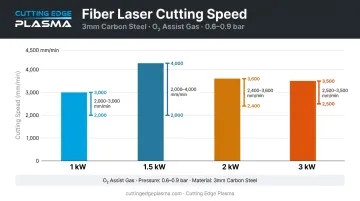
Note: These are one manufacturer's published settings. Treat them as a starting baseline, not universal values — actual optimal parameters vary by machine, tube geometry, and material grade.
These speed ranges, combined with the tight tolerances and minimal HAZ, explain why fiber laser tube cutting has become the default for production work on 3mm steel across automotive, trailer, and structural fabrication applications.
Key Parameters for Cutting 3mm Steel Tubes with a Fiber Laser
Getting 3mm tube cuts right comes down to four variables: power, assist gas, cutting speed, and focus position. Get one wrong and you're looking at dross, incomplete cuts, or a burnt-through opposite wall.
Laser Power Selection
A 1kW–2kW fiber laser cuts 3mm steel tube cleanly for most applications. Moving to 2kW–3kW adds throughput without sacrificing edge quality, making it the better choice for production environments running high volumes.
Assist Gas: Oxygen vs. Nitrogen
TRUMPF confirms the mechanism directly: oxygen flame cutting oxidizes the metal melt, and the chemical reaction supports the laser beam — accelerating the cut. Nitrogen fusion cutting doesn't react with the metal surface, keeping edges free of oxides.
Practical guide for 3mm steel:
- Oxygen (O₂) — Carbon steel tube: 0.6–0.9 bar pressure, faster speeds, oxidized edge (acceptable for structural/welded applications)
- Nitrogen (N₂) — Stainless steel tube: 12–15 bar pressure, bright clean edge, required for food-grade or visible aesthetic applications
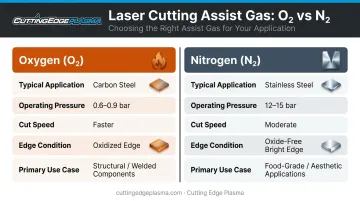
The higher nitrogen pressure (12–15 bar vs. 0.6–0.9 bar for oxygen) reflects how N₂ works: it relies purely on mechanical ejection rather than chemical reaction to clear molten material.
Focus Position
Focus settings differ by material at 3mm, per GWEIKE's tube parameter chart:
- Carbon steel with O₂: Positive focus values (+2mm to +5.5mm depending on power)
- Stainless steel with N₂: Negative focus values (-2.5mm to -3mm)
Modern tube lasers handle focus adjustments on the fly. Precitec confirms that intelligent sensors enable real-time focus adjustment, with capacitive clearance control maintaining a constant working distance as the tube rotates — critical for round profiles where the surface height changes continuously.
Weld seam behavior is the other variable that focus settings alone can't solve, which is where material-aware CNC control takes over.
Weld Seam Management
Roll-formed 3mm steel tube has a weld seam with different metallurgical properties than the base material. It cuts differently and can cause incomplete cuts or burn-through if the machine doesn't account for it.
As The Fabricator reports, the CNC controller automatically adjusts power, frequency, and duty cycle as the laser crosses the seam. BLM Group's Active Weld system and Bodor's inner weld seam recognition use camera and image-algorithm detection to locate seams before cutting begins.
How to Optimize Cut Quality on 3mm Steel Tubes
Nozzle Selection
For 3mm carbon steel with oxygen assist, GWEIKE's nozzle guide specifies a 1.2mm double nozzle. For stainless steel with nitrogen, a 2.0–2.5mm single nozzle is standard. A worn or damaged nozzle creates uneven gas flow — on thin-walled 3mm material, that shows up immediately as dross streaks and inconsistent edge quality.
Inspection indicators:
- Visible deformation or asymmetry in the nozzle orifice
- Dross patterns that appear on one side of cuts only
- Sudden drop in edge quality with no other parameter changes
Replace nozzles at the first sign of orifice damage. On high-volume jobs, build a routine check into shift changeovers.
Tube Straightness and Compensation
No tube stock is perfectly straight. Canadian Metalworking reports that raw tube commonly shows bow, twist, sagging in longer lengths, and wall-thickness variation — all of which shift the tube surface away from the optimal focal point mid-cut.
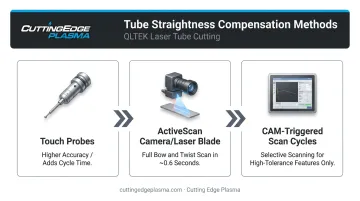
Advanced machines address this with:
- Touch probes — measure bow and twist before cutting; higher accuracy, adds cycle time
- ActiveScan cameras/laser blades — scan bow and twist in approximately 0.6 seconds
- CAM-triggered scan cycles — activate measurement only for high-tolerance features, preserving throughput on simpler cuts
Nesting and Material Efficiency
When processing multiple parts from a single 3mm tube, software nesting directly determines material yield. Nesting parts end-to-end minimizes the tail offcut left in the chuck. Some manufacturers offer zero-tail or near-zero-tail configurations for high-volume work.
Common-line cutting (sharing a single cut between adjacent parts) and fly cutting (cutting while the tube continues feeding without stopping) both cut cycle time on high-volume runs.
Optics and Lens Maintenance
Throughput gains mean nothing if contaminated optics degrade cut quality. Zinc vapor from galvanized 3mm tube is particularly damaging. GWEIKE notes that zinc vaporizes at 907°C, producing fine oxide particles that contaminate the protective window, scatter the beam, and produce rough cuts with jitter marks.
Bystronic recommends checking laser optics for dirt and damage regularly, cleaning lenses with proper kits, and replacing lenses annually as part of planned maintenance. On heavy-production shifts cutting galvanized tube, inspect the protective window at every shift change.
Industries and Applications for 3mm Steel Tube Laser Cutting
3mm wall steel tube appears across a wide range of end products. The common thread: these applications need either complex geometry, tight fit-up tolerances, or both.
Structural Fabrication and Construction
Handrails, security gates, fencing, and support frames all use 3mm wall tube extensively. Fiber laser cuts coped ends, through-holes, and compound notches weld-ready — no hand-grinding or template-fitting required. Automotive chassis and roll cage fabrication is another major category where 3mm steel tube is standard and precision matters.
Furniture, Signage, and Architectural Metalwork
Custom furniture manufacturers and sign fabricators use 3mm tube for table bases, display frames, and decorative brackets. Fiber laser makes it practical to cut logos, patterns, and slot-and-tab joinery directly into tube walls — work that's too slow for plasma and impractical with conventional tooling.
Other industries where 3mm tube laser cutting is common:
- Agricultural equipment frame sections, implement guards, and structural members — consistent geometry directly affects assembly fit
- Conveyor support frames and cross-members where precise hole placement determines roller shaft alignment
- HVAC support hangers and duct framework where weld-ready cuts reduce installation labor
Fiber Laser vs. Plasma Cutting for 3mm Steel: A Practical Comparison
The Core Trade-Off
Fiber laser produces tighter tolerances, narrower kerf, cleaner edges, and minimal heat distortion on 3mm steel. Plasma at this thickness produces a wider kerf (Hypertherm's Powermax45 FineCut chart shows 1.3mm kerf on 3mm mild steel), more dross, and edges that typically need grinding before welding or finishing. Hypertherm's own comparison notes that laser and plasma tolerances differ by approximately 0.25mm.
For precision parts, complex 3D notching, and weld-ready components, fiber laser delivers what plasma simply can't at 3mm: weld-ready edges, tighter repeatable tolerances, and clean geometry on complex profiles.
Cost and Accessibility
StyleCNC's 2026 pricing data puts entry-level fiber laser tube machines starting around $20,800, with an average market cost near $50,000. That's before factoring in premium OEM pricing from TRUMPF, BLM, or Mazak, which runs significantly higher — often $150,000+.
CNC plasma table systems represent a substantially lower capital entry point. Cutting Edge Plasma's iPlasma XTREME series starts at $17,495. For shops that also need flat plate cutting and can work within plasma tolerances, that price difference is substantial.
Decision Framework
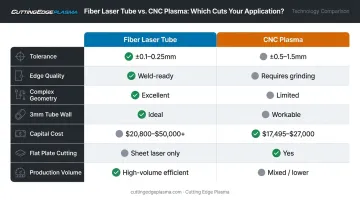
| Factor | Fiber Laser Tube | CNC Plasma |
|---|---|---|
| Tolerance requirement | ±0.1–0.25mm | ±0.5–1.5mm |
| Edge quality | Weld-ready, clean | Requires grinding |
| Complex geometry | Excellent | Limited |
| 3mm tube wall | Ideal range | Workable |
| Capital cost | $20,800–$50,000+ | $17,495–$27,000 |
| Also cuts flat plate? | Sheet laser only | Yes (same table) |
| Production volume | High-volume efficient | Better for mixed/lower volume |
Frequently Asked Questions
How fast can a laser cut 3mm steel?
For 3mm carbon steel tube, a 1kW fiber laser cuts at 2,000–3,000 mm/min and a 2kW system reaches 2,400–3,600 mm/min with oxygen assist gas (GWEIKE tube parameter data). In production, actual throughput depends on total part cycle time, including part handling, not raw cut speed alone.
How thick of steel can a laser tube cutter process?
Fiber laser tube cutters handle steel from under 1mm up to approximately 14mm wall thickness at higher power levels (TRUMPF's TruLaser Tube 7000 lists 14mm mild steel capacity at 9kW). For tube systems in the 1–6kW range, 3mm sits well within the efficient operating window.
Can fiber lasers cut steel?
Fiber lasers cut steel reliably across carbon, mild, stainless, and galvanized grades. Their 1,070nm wavelength is readily absorbed by ferrous metals, making them faster and more energy-efficient than CO₂ lasers at thin-to-medium thicknesses.
What laser power is needed to cut 3mm steel tube?
A 1kW–2kW fiber laser cuts 3mm steel tube cleanly for most applications. A 2kW–3kW machine offers higher speed and throughput for production environments. At 1kW with oxygen assist, GWEIKE's published data shows 2,000–3,000 mm/min on 3mm carbon steel.
What is the best assist gas for laser cutting 3mm carbon steel tube?
Oxygen is the standard choice for 3mm carbon steel — it reacts exothermically with the melt, accelerating cut speed and reducing the laser power required. Nitrogen is preferred for stainless steel at 3mm, preventing edge oxidation and producing a bright, clean finish suitable for visible or food-grade applications.