The consequences of a bad selection are real: poor edge quality on complex geometries, a chuck system that won't grip your tube profiles, and a machine that burns through the far wall on small-diameter tube. The right machine, matched correctly to your material mix, improves throughput and part consistency from day one.
This guide covers the six selection factors that matter most: laser source type, power output, chuck compatibility, weld seam handling, material handling, and software control.
Key Takeaways
- Fiber lasers are the only practical choice for cutting metal tubes — CO2 lasers reflect off metallic surfaces
- Power output must match both tube wall thickness and tube diameter; too much power burns through the far wall
- Chuck system design determines which profiles your machine can handle — verify this against your actual part mix
- Weld seam detection is a production-grade differentiator that most entry-level machines lack
- Total part cycle time, not peak cutting speed, is the true productivity metric in tube laser work
What Is a Laser Cutter for Metal Tube Cutting?
A tube laser cutter is a fiber laser machine engineered specifically to process hollow profiles — round, square, rectangular, and others — by rotating and indexing the workpiece beneath a focused laser beam, coordinated by a CNC system across multiple simultaneous axes.
Two machine configurations exist:
- Dedicated tube-only machines — purpose-built for tube processing with advanced tube handling, higher throughput, and more specialized automation
- Combination sheet-and-tube machines — offer flexibility for shops already running flat sheet work, with tube capability added to the same platform
Shops with a heavy tube focus generally benefit from dedicated machines. Shops that split time between sheet and tube may find combination systems more practical.
Core Components
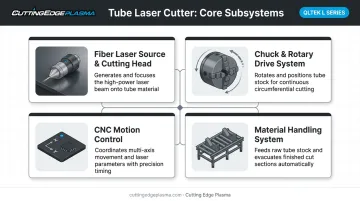
Every tube laser cutter shares four functional subsystems:
- Fiber laser source and cutting head — delivers the focused beam that cuts through tube walls at speed
- Chuck and rotary drive system — grips and rotates the tube so the beam can reach every face and angle
- CNC motion control — synchronizes all axes in real time, translating CAD geometry into precise cuts
- Material handling system — feeds raw stock in and pulls finished parts out, automatically or semi-automatically
Why Industries Rely on Tube Laser Cutting
Those four subsystems work together to collapse what used to be a multi-machine workflow into a single setup. Parts with slotted ends, mitered joints, punched holes, and complex profiles come off one machine — complete.
Key operational benefits:
- Tight dimensional tolerances reduce downstream fitting and welding labor
- Contactless cutting eliminates tooling wear costs entirely
- Complex geometries cut in one operation reduce secondary processing
- High automation potential lowers labor cost per part at volume
Industries including automotive, furniture, aerospace, construction, and agricultural equipment manufacturing rely on this consolidation effect. The global tube laser cutting machine market is projected to grow at a 5.9% CAGR through 2031, reflecting broad adoption across manufacturing sectors.
Key Factors When Selecting a Laser Cutter for Metal Tube Cutting
Tube cutting selection is more complex than sheet metal. Geometry, rotation, and material feeding introduce additional mechanical and process variables — and each factor below connects a specification directly to a measurable operational outcome.
Laser Source Type: Fiber vs. CO2
Fiber lasers are the only practical choice for metal tube cutting. Fiber lasers operate at approximately 1.07 microns wavelength, a near-infrared frequency that metals absorb efficiently. CO2 lasers operate at 10.6 microns, a wavelength that reflects off metallic surfaces including steel, stainless, aluminum, brass, and copper. That reflection can damage CO2 optical components and produce inconsistent, unusable cuts.
Beyond wavelength suitability, fiber lasers offer specific operational advantages for tube shops:
- Fiber laser generators are briefcase-sized modules, not large resonator cabinets
- Fiber-optic beam delivery eliminates the alignment and maintenance demands of CO2 mirror systems
- No mirror cleaning, bellow checks, or resonator gas management required
- More input power reaches the workpiece, reducing energy costs per part
For a tube shop running multiple shifts, these maintenance differences add up fast in uptime and operating cost.
Power Output: Matching Wattage to Wall Thickness
Unlike flat sheet cutting, where higher wattage reliably means faster throughput, tube cutting involves a more specific trade-off. On small-diameter tube, excessive power risks burning through the far wall during cutting, damaging the part and potentially the machine.
Shop Metalworking Technology notes that when tube is processed at maximum power, there are cases where the beam can cut through both walls, particularly on tube under 1 inch in diameter. Power must be matched to both wall thickness and tube geometry.
Current production machines span a wide power range. Manufacturer specifications map to capability as follows:
| Power Range | Example Machines | Typical Capacity |
|---|---|---|
| 3 kW | TRUMPF TruLaser Tube 3000, Mazak FT-150 FIBER | Up to ~8 mm mild steel, ~6 mm stainless/aluminum |
| 3–4 kW | Bystronic ByTube Star 130, LVD TL 8525-FL | Most structural and industrial tube profiles |
| 4 kW | Mazak FG-220 | Long pipe and structural material (3D fiber) |
| 9 kW | TRUMPF TruLaser Tube 7000 | Up to 14 mm mild steel, 12.5 mm stainless/aluminum |
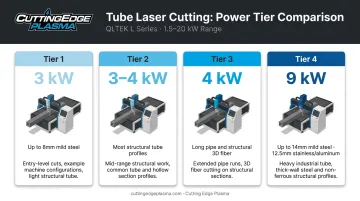
Match power to your wall thickness requirements, not to a general "more is better" assumption. A 3–4 kW fiber laser covers the majority of structural and industrial tube applications. Higher power machines are built for heavy-wall tube and larger profiles, not for every shop.
Chuck System and Tube Profile Compatibility
The chuck and rotary drive system determines which tube cross-sections your machine can actually handle. A machine with limited chuck compatibility locks your shop into a narrow product mix, which directly limits revenue potential.
Verify these specifications against your actual part requirements:
- Maximum tube diameter and circumscribed circle (the smallest circle that fully contains the tube profile)
- Supported cross-sections: round, square, rectangular, oval, and custom profiles
- Chuck jaw range and whether quick-change jaws are available for mixed-profile production
- Minimum tube length the chuck system can grip and feed reliably
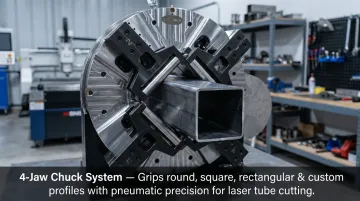
Profile compatibility gaps aren't always obvious at the quoting stage. Ask vendors for a profile matrix that shows exactly which shapes each chuck configuration supports at full rated speed.