Introduction
Fiber laser cutting has reshaped what's possible on the shop floor. Tasks that once demanded plasma cutters or sluggish CO2 systems now get done faster, cleaner, and to tighter tolerances — which is why these machines show up in automotive plants, aerospace suppliers, and job shops of every size.
The challenge for buyers in 2026 is the sheer volume of options. According to Mordor Intelligence, the broader laser cutting machine market is projected to reach $7.82 billion in 2026 and grow to $12.34 billion by 2031 at a 9.55% CAGR — with fiber lasers already capturing 51.72% of market share. That growth has pulled dozens of manufacturers into the space, and with overlapping spec sheets and aggressive marketing claims on every side, sorting credible machines from overpromised ones takes real digging.
The 10 machines below span industrial-grade European systems to US-assembled options built for smaller shops. Each was evaluated on cutting performance, laser source quality, after-sales support, and practical fit for the US fabrication market.
Key Takeaways
- Fiber lasers now dominate the cutting machine market, holding over half of global share
- European brands (TRUMPF, Bystronic, AMADA) lead on precision; Chinese brands (Han's, Bodor) compete on power and price
- Power selection matters more than most buyers realize: match wattage to your actual material thickness, not the highest number on a spec sheet
- US-based after-sales support separates good options from great ones, especially for smaller shops without in-house service teams
- CNC plasma tables are worth considering for shops cutting thick mild steel — or when upfront budget is under $30,000
What Is a Fiber Laser Cutting Machine?
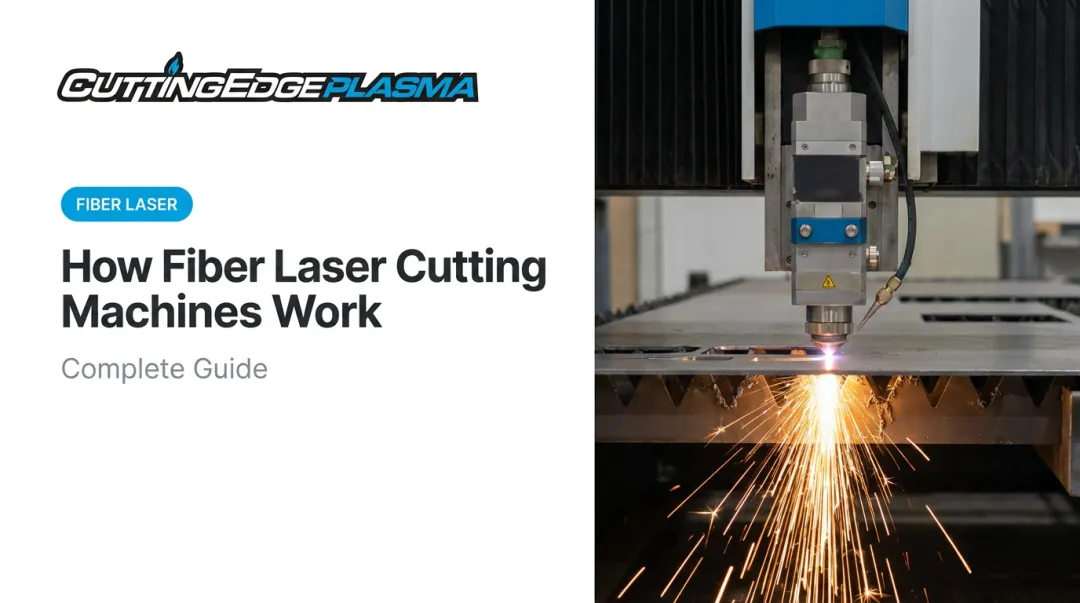
A fiber laser cutting machine is a CNC-controlled system that delivers a high-intensity laser beam through fiber-optic cable to melt and cut metal with tight tolerances. Rare-earth-doped fiber generates the beam; a cutting head then focuses it onto the material while assist gas (nitrogen, oxygen, or air) ejects the molten material cleanly.
How it compares to the main alternatives:
| Technology | Best For | Tradeoff |
|---|---|---|
| Fiber Laser | Thin-to-medium metals, high precision | Higher upfront cost |
| CO2 Laser | Non-metals (wood, acrylic), some metals | Slower on reflective metals |
| Plasma Cutter | Thick mild steel, lower budget entry | Less precision, wider kerf |
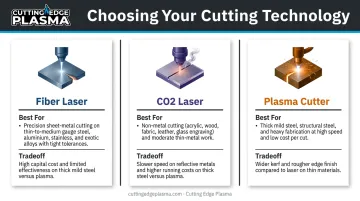
According to Hypertherm, plasma cutters carry a 2–5x lower initial investment than comparable fiber laser systems and maintain advantages on material above 16mm. For high-volume sheet metal work where edge quality and cut speed matter, fiber laser pulls ahead — which is why it dominates the machines covered in this guide.
Top 10 Fiber Laser Cutting Machines in 2026
These machines were selected based on laser source quality, cutting speed, supported materials, bed size options, and after-sales support relevance for US buyers — listed in no particular order.
TRUMPF TruLaser Series (Germany)
Founded in 1923, TRUMPF is one of the most established names in industrial laser technology. Their TruLaser 3000 fiber series covers everything from mid-size flatbed cutting to massive-format systems used in automotive and aerospace production.
| Spec | Details |
|---|---|
| Laser Power | 4, 6, 9, 12, or 24 kW |
| Max Speed | 170 m/min simultaneous |
| Working Area | 3030: 3000×1500mm up to 3080: 8000×2500mm |
| Notable Features | BrightLine fiber, CoolLine, Nanojoints, EdgeLine Bevel (up to 50°) |
| Best For | High-volume industrial manufacturers requiring maximum uptime |
TRUMPF's integrated manufacturing software connects machine data to scheduling and quality systems, which matters for shops running multi-shift production. The Bevel Cut Edition adds weld-ready edge preparation directly on the machine, so fabricators skip a separate beveling step between cutting and welding.
Bystronic ByStar Fiber (Switzerland)
Established in 1964, Bystronic focuses on sheet metal processing automation. The ByStar Fiber is one of their flagship systems, available at power levels reaching 30 kW — among the highest in the flatbed fiber laser category.
| Spec | Details |
|---|---|
| Laser Power | Up to 30 kW |
| Max Positioning Speed | ~170 m/min |
| Bed Size | Up to 319×100 in (8025 model) |
| Notable Features | BeamShaper for cut quality control, automated material handling |
| Best For | Sheet metal fabricators needing precision at industrial throughput |
BeamShaper is Bystronic's proprietary beam-profile control: it adjusts automatically as material thickness changes, which keeps burr levels consistent without an operator stopping to tweak parameters between runs.
AMADA ENSIS Series (Japan)
AMADA, founded in 1946, is a major Japanese sheet metal machinery manufacturer. The ENSIS series uses AMADA's own fiber laser oscillator with beam-control technology that handles both thin and thick materials from a single resonator without requiring lens changes between thickness ranges.
| Spec | Details |
|---|---|
| Laser Power | 2, 3, 6, 9, 12, or 15 kW |
| Material Range | 1.0mm SPC/SUS304 to 19.0mm SS400 |
| Notable Features | Single-resonator beam control, automatic nozzle centering, energy-efficient |
| Best For | Job shops cutting varied thicknesses with frequent material changeovers |
For job shops rotating between 2mm stainless and 16mm mild steel in the same shift, avoiding lens swaps translates directly into less downtime and lower consumable spend per part.
IPG Photonics LaserCube (USA)
IPG Photonics manufactures the fiber laser sources inside many competitors' machines ; the LaserCube is their own complete flatbed cutting system, built specifically for precision small-to-medium part production.
| Spec | Details |
|---|---|
| Power | Up to 6 kW |
| Working Range | 1250×1250×75mm (XYZ) |
| Positioning Accuracy | ±25 micrometers |
| Repeatability | <10 micrometers |
| Max Speed | 1,000 mm/sec |
| Notable Features | Natural granite base, high-precision linear motors |
| Best For | Precision manufacturers cutting small parts with tight tolerances |
Granite absorbs vibration where steel frames transmit it. At ±25-micron repeatability requirements, that difference shows up in part quality across long production runs.
Coherent ExactCut Series (USA)
Coherent, with $5.81 billion in FY2025 revenue, builds cutting and drilling systems for demanding applications across metals, ceramics, sapphire, and composites. Their ExactCut platform is engineered for high-precision industrial applications.
| Spec | Details |
|---|---|
| Power | 1.5 kW or 3.0 kW (ExactCut 430) |
| XY Positioning Accuracy | ±0.002mm |
| XY Repeatability | ±0.001mm |
| Travel | 400×500mm |
| Notable Features | Precision optics integration, multi-material cutting capability |
| Best For | Aerospace and advanced manufacturing requiring ultra-tight tolerances |
Han's Laser F Master (China)
Founded in 1996 and publicly listed on the Shenzhen Stock Exchange, Han's Laser is China's largest industrial laser manufacturer with $2.67 billion in 2025 revenue. Their F Master series covers an exceptional power range for large-scale production.
| Spec | Details |
|---|---|
| Laser Power | 3–60 kW |
| Max Axis Speed | 200 m/min |
| Acceleration | Up to 3.5G |
| Materials | Carbon steel, stainless, aluminum, copper, brass |
| Notable Features | Ultra-high-power options, automated material handling |
| Best For | Large manufacturers needing high-volume capacity at competitive pricing |
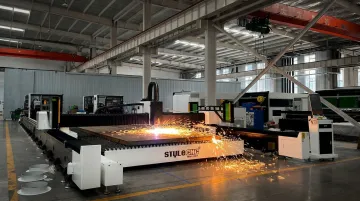
Han's significant footprint in EV battery enclosure and electronics manufacturing reflects where 60 kW cutting capacity actually gets used: high-mix, high-volume lines running copper and aluminum around the clock.
Bodor Laser A Series (China)
Established in 2008, Bodor is among the fastest-growing fiber laser manufacturers. Their A Series covers an enormous power range, with 60 kW systems already deployed in production environments.
| Spec | Details |
|---|---|
| Laser Power | 1.5–60 kW |
| Bed Size | 3048×1524mm to 14000×3100mm |
| Thickness (12 kW) | Carbon/stainless steel up to 40mm, aluminum up to 30mm |
| Notable Features | BodorPro2.0 intelligent CNC software, adaptive processing |
| Best For | Manufacturers cutting very thick plate who want automation at a competitive price |
BodorPro2.0 imports G-code, DXF, PLT, and ENG files natively. On complex nested jobs, that native compatibility removes the file conversion step that costs operators time at the start of every shift.
SENFENG America SF3015H (China/USA)
SENFENG operates US locations in Ontario, CA and Houston, TX, combining Chinese manufacturing scale with local inventory and technical support so American fabricators get local inventory access without waiting on overseas freight.
| Spec | Details |
|---|---|
| Laser Power | 12–30 kW |
| Bed Size | 120×60.2 in (approx. 5×10 ft) |
| US Locations | Ontario, CA and Houston, TX |
| Notable Features | US-based support and inventory, financing available |
| Best For | Small-to-mid-sized US fabrication shops wanting industrial performance without premium European pricing |
When a machine goes down, response time is everything. Having technicians and parts in-country rather than coordinating across time zones makes a measurable difference in how fast a shop gets back to cutting.
Boss Laser FC-6012 EXT (USA)
Boss Laser designs and engineers their FC series in the USA, targeting fabricators who need production-capable machines without enterprise-level budgets.
| Spec | Details |
|---|---|
| Laser Power | 3–30 kW |
| Working Area | 59×118 in (1500×3000mm) |
| Thickness (3 kW) | Carbon steel up to 18mm |
| Frame | 6061-T6 aluminum gantry, premium servo motors |
| Notable Features | Optional IPG laser source, CypCUT/HypCUT software, 2-year warranty |
| Best For | Small fabrication shops and custom metalwork businesses entering fiber laser cutting |
A 30-day money-back guarantee and lifetime support policy are meaningful for first-time fiber laser buyers: they lower the cost of getting the decision wrong, which encourages shops to commit rather than wait.
Cincinnati Incorporated CI Fiber (USA)
Cincinnati Incorporated has over 125 years of metal fabrication machinery history, based in Harrison, OH. Their CI Fiber laser systems are engineered for heavy-duty environments running continuous production.
| Spec | Details |
|---|---|
| Laser Power | 5, 8, 10, 12, 15, 16, or 20 kW |
| Table Sizes | 3015 through 7525 |
| Automation | MARCH 400 material handling compatible |
| Notable Features | Heavy-duty frame construction, high-volume throughput design |
| Best For | Heavy industrial fabricators cutting thick steel plate around the clock |
Cincinnati builds frame rigidity for sustained high-acceleration production, not peak-spec demonstrations. Shops running 20-hour days on thick plate will see that difference in dimensional consistency over time.
How to Choose the Right Fiber Laser Cutting Machine
Match Power to Your Material
The biggest buyer mistake is choosing wattage based on what sounds impressive rather than what the work actually requires.
- 1–3 kW: Optimal for thin sheet metal; stainless 1–6mm at best speed and quality
- 4–6 kW: Handles medium thicknesses; carbon steel up to 25mm, stainless to 20mm with the right setup
- 10 kW+: Thick plate cutting; 12 kW reaches carbon steel and stainless at 40mm+
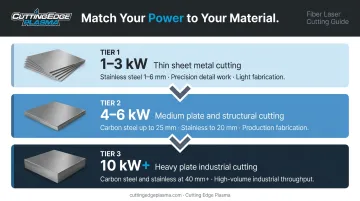
Power-to-thickness varies by material, assist gas, and cut quality target. Use manufacturer cut charts for your specific applications — not generic guides.
Evaluate Total Cost of Ownership
Purchase price is only the starting point. Factor in:
- Consumables — nozzles, lenses, assist gas (nitrogen costs significantly more than oxygen or air)
- Maintenance contracts — especially for European systems where local service may involve travel costs
- Controller and software — some machines require proprietary software with licensing fees
- Motion system quality — linear motors cost more but reduce long-term maintenance versus rack-and-pinion systems
Prioritize After-Sales Support
Those total cost factors don't end at the machine itself. For US buyers, service access is often the deciding variable — a machine sitting idle for three weeks waiting on international support will cost far more than any price premium on a domestically backed system.
Questions to ask before buying:
- Where is the nearest service technician?
- What is the typical response time for a critical failure?
- Are spare parts stocked domestically?
- What does the warranty actually cover — and what does it exclude?
Conclusion
The 2026 fiber laser cutting machine market covers enormous ground: from TRUMPF's high-power industrial systems used in global automotive production to Boss Laser and Cincinnati Incorporated machines built specifically for American fabricators at more accessible price points.
There is no single "best" machine. The right choice depends entirely on what you're cutting, how much of it, and what support infrastructure your operation can realistically rely on.
Evaluate your most common material type and thickness first, then work backward to the power level you actually need. From there, let production volume, bed size requirements, and support access narrow the field.
For fabricators and small business owners who need reliable metal cutting but find fiber laser systems outside their current budget, Cutting Edge Plasma's CNC plasma tables offer a proven US-built alternative with integrated torch height control, lifetime technical support, and pricing from $17,495. For shops cutting mild steel — especially thicker plate where plasma genuinely competes with laser — talk to them before committing to a six-figure investment.
Frequently Asked Questions
What are the top 10 brands of fiber laser cutting machines?
The most recognized global brands are TRUMPF, Bystronic, AMADA, IPG Photonics, Coherent, Han's Laser, Bodor Laser, SENFENG, Boss Laser, and Cincinnati Incorporated. Your best fit comes down to your industry, required power level, and whether US-based service and support matter to your operation.
How much does a fiber laser cutting machine cost?
Public pricing is limited, but verified data shows mid-range industrial systems starting around $134,900 (Piranha SP404 3 kW) and reaching $282,000+ for larger configurations. Entry-level and high-power European systems vary widely — most major brands require direct quotes.
What is the difference between a fiber laser cutter and a plasma cutter?
Fiber lasers use a focused light beam for high-precision cuts on thin-to-medium metals with minimal heat distortion and a narrow kerf. Plasma cutters use ionized gas and are more practical for thicker mild steel — Hypertherm's research shows plasma maintains advantages above 16mm with 2–5x lower initial investment.
What power level do I need for a fiber laser cutting machine?
1–3 kW works well for thin sheet metal up to around 6mm at optimal quality; 4–6 kW handles medium thicknesses into the 20–25mm range; 10 kW+ is for thick plate production. Match wattage to your most common material and thickness rather than buying for occasional edge cases.
What materials can fiber laser cutting machines cut?
Fiber lasers cut carbon steel, stainless steel, aluminum, copper, brass, and titanium effectively. They are not suited for non-metals like wood or acrylic — CO2 lasers handle those materials better.
Is a fiber laser cutting machine worth it for a small business?
For shops with consistent metal cutting demand, the investment can pay off — especially when precision on stainless or aluminum justifies the cost. For budget-conscious fabricators and hobbyists cutting primarily mild steel, a CNC plasma table is a more accessible starting point. Cutting Edge Plasma carries both QLTEK fiber laser systems and iPlasma XTREME CNC plasma tables, so you can match the right technology to your actual workload.