The range is genuinely wide. Compact entry-level units start under $20,000, while fully automated industrial systems can exceed $500,000. That spread trips up buyers who assume a single price point applies to their use case — and it leads to real mistakes: underbudgeting, wrong-spec purchases, or unexpected upgrade costs after delivery.
This guide breaks down the 2026 price landscape across all tiers, explains what actually drives costs up or down, and helps fabricators, shop owners, and hobbyists determine what they need to budget — including costs beyond the purchase price that most buyers overlook.
Key Takeaways
- Entry-level fiber laser cutters start at $15,000–$50,000; mid-range industrial machines run $50,000–$200,000; high-end automated systems exceed $300,000–$600,000+
- Laser power (wattage) is the single biggest price driver — roughly $8,000–$12,000 per additional kilowatt
- Operating costs (gas, electricity, maintenance, and installation) typically add 20–40% annually on top of purchase price — total cost of ownership matters as much as the sticker price
- Chinese-manufactured machines cost 30–50% less upfront, but freight, import duties, and remote support gaps close that gap faster than most buyers expect
- CNC plasma tables are a lower-cost alternative for shops cutting thicker steel where edge finish tolerances are less demanding
How Much Does a Fiber Laser Cutting Machine Cost in 2026?
Fiber laser cutting machines don't carry a single fixed price — and misreading that range leads to real problems. Buyers who focus only on the sticker price often underestimate the power needed for their material thickness, skip factoring in assist gas costs, or purchase an import without verifying US after-sales support.
According to Accurl's 2026 manufacturer pricing guide, the market spans from $15,000 for compact 1kW systems to over $600,000 for 20kW+ automated cells — with each tier serving a distinctly different buyer.
Entry-Level ($15,000–$50,000)
Entry-level machines run 1,000W–2,000W with standard 4×8 ft cutting beds, typically sourced from Chinese manufacturers using Raycus or Max Photonics laser sources. Accurl lists 1–3kW systems at $15,000–$40,000, with 1.5kW units around $20,000–$30,000.
At this price point, expect a basic CNC controller and manual loading — but not automation, dual-pallet systems, premium nesting software, or US-based warranty service. That last point matters: import machines at this tier often carry limited post-sale support, which becomes a real cost if something goes wrong.
Best for: Hobbyists, small metal fabrication shops, startups cutting thin steel or aluminum (up to ~6mm), and businesses testing fiber laser economics before scaling up.
Mid-Range ($50,000–$200,000)
Mid-range machines step up to 3kW–6kW with larger cutting beds (up to 5×10 ft), faster servo motors, auto-focus cutting heads, and nesting software. As a specific example, the QLTEK H SERIES — available through US distributors like Cutting Edge Plasma — starts at $54,000 for a 3kW configuration and scales to 6kW across 5×10 ft, 6½×13 ft, and 5×20 ft table sizes. Imported fiber laser cutters in this class commonly run $60,000–$200,000 depending on specs and sourcing.
US-based or European-sourced machines in this range offer stronger local support and warranty terms — worth the premium for production shops that can't afford extended downtime.
Best for: Established fabrication shops, job shops with consistent production volume, and businesses cutting material thicknesses up to 16–20mm.
High-End / Industrial ($200,000–$600,000+)
Industrial-tier machines run 8kW–20kW+ and are built around throughput. Standard features include:
- Auto loading/unloading towers and dual-pallet systems
- Remote monitoring and advanced CAM software
- IPG or nLIGHT premium laser sources
- High-speed servo drives rated for continuous production cycles
Some fully automated cells integrated into larger production lines exceed $1M.
Best for: High-volume manufacturers in automotive, aerospace, and structural steel fabrication where machine uptime and cut speed set the ceiling on shop revenue.
Key Factors That Affect Fiber Laser Cutter Prices
Pricing is shaped by technical specifications, manufacturing origin, and support infrastructure. Knowing which factors drive cost helps you match machine specs to your actual production needs — without overspending on capabilities you won't use.
Laser Power (Wattage)
Power is the single biggest cost driver. Accurl's 2026 guide confirms that each additional kilowatt of fiber laser power adds roughly $8,000–$12,000 to machine cost. Higher wattage enables faster cutting speeds and the ability to cut thicker materials — but only matters if your material specs actually require it.
| Power Level | Mild Steel (Stable) | Stainless Steel (Stable) | Aluminum (Stable) |
|---|---|---|---|
| 1–2 kW | 4–6 mm | 2–4 mm | 1.5–3 mm |
| 3–4 kW | 8–12 mm | 6–8 mm | 4–6 mm |
| 6 kW | 15–20 mm | 10–15 mm | 8–10 mm |
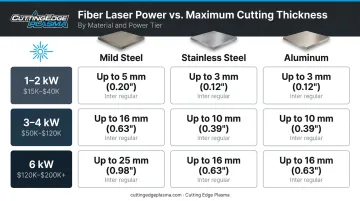
Source: GWEIKE manufacturer thickness chart; "stable" means clean, repeatable production cuts.
Cutting Bed Size
Larger cutting tables — say, upgrading from a 4×8 to a 5×20 configuration — add meaningfully to machine cost, shipping weight, installation footprint, and facility power requirements. Buyers should request itemized quotes that separate bed size upgrades from power upgrades, as manufacturers price these differently.
Laser Source Brand and Quality
Budget sources (Raycus, Max Photonics) offer solid performance for most sheet metal applications and carry lower upfront costs. For many fabrication shops cutting standard mild steel or stainless, they're the practical choice.
Premium brands (IPG Photonics, nLIGHT) deliver better beam quality, more stable performance on reflective metals like copper and brass, and longer rated component lifespans. They add substantially to the purchase price, and the exact premium varies by machine configuration — it isn't publicly standardized.
Automation and Software Features
Automation add-ons can add $20,000–$100,000+ to base machine price:
- Automatic material loading/unloading systems
- Dual-pallet exchange for continuous production
- Nesting and CAM software licenses
- Remote diagnostics and monitoring
For high-volume shops, these features reduce labor costs and can pay back in months. Low-volume buyers rarely justify the investment.
Country of Manufacture and Tariffs
Chinese-manufactured machines dominate the $15,000–$80,000 range and offer significant upfront savings. Senfeng USA reports Chinese fiber laser cutters run 30–50% lower than American or European equivalents, though buyers should add 10–30% for shipping and setup costs.
US buyers also face import duties that can shift the total cost picture considerably:
- General duty: 2.4% on China-origin laser cutting machines (CBP ruling N334884, HTSUS 8456.11.9000)
- Section 301 China duty: Additional 25% on top of the general rate
- Freight: $3,000–$8,000 per 40-ft container from Asian manufacturers to North America
Run the full landed cost — machine price plus duties plus freight plus installation — before comparing any Chinese import against a domestic or European alternative.
Full Cost Breakdown: Beyond the Purchase Price
The sticker price is only one piece of total cost of ownership. Recurring costs — gas, electricity, consumables, and maintenance — can add thousands of dollars per year that never appear in the purchase quote.
Installation, Infrastructure, and Setup
One-time costs to budget:
- Site electrical: A 3kW fiber laser requires roughly 18–30kW of facility supply; a 6kW system needs 30–50kW, with 25% headroom recommended. Most installations require 3-phase power.
- Installation and infrastructure: Accurl estimates $5,000–$25,000 for site preparation
- Operator training: $800–$2,500 for formal courses
- Gas supply setup: $5,000–$20,000 for nitrogen/oxygen assist gas infrastructure
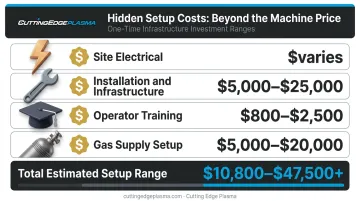
Standard purchase prices typically exclude all of these.
Operating Costs (Recurring)
Electricity costs are smaller than most buyers expect. Using EIA's April 2026 US industrial electricity rate of 8.66 cents/kWh and Accurl's consumption figures (7.5kW for a 3kW laser, 10kW for a 4kW laser), electricity-only operating cost runs roughly:
- 3kW system: ~$0.65/hr
- 4kW system: ~$0.87/hr
Assist gas is where costs climb fast. Piranha's data shows nitrogen ranging from $8.30/hr at lower flow rates to $23.03/hr for cutting 10-gauge to 1/4-inch steel. Oxygen runs $0.80–$10/hr depending on flow and material. Bulk tank rental and delivery add another $3–$10/hr.
Gas assumptions vary by nozzle size, pressure, material, and duty cycle — get a real quote based on your specific cut plan.
Fiber lasers are substantially more efficient than CO2 systems. Accurl's 2026 guide estimates fiber laser operating cost around $4/hr versus CO2 at roughly $20/hr, though actual figures depend heavily on application.
Maintenance, Consumables, and Repairs
Routine consumable costs to plan for:
- Lenses: Approximately $80 per replacement
- Focus nozzles: Typically erode after ~1,500 hours
- X/Y belts: Rated for approximately 10,000 hours
- Air filter elements: Replace at least once per year
Machines without strong US-based after-sales support create compounding risk — when a spare part takes weeks to arrive from overseas, downtime costs can dwarf the original savings from buying cheap.
Low-Cost vs. High-Cost Fiber Laser Cutters — What's the Real Difference?
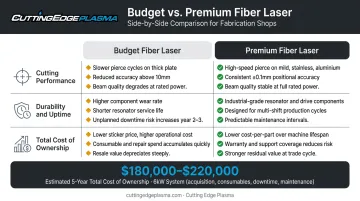
Budget and premium fiber laser cutters differ across three areas that affect long-term profitability far more than the sticker price suggests:
- Cutting performance — High-end machines with premium laser sources cut faster and produce cleaner edges on reflective metals. Entry-level machines can struggle with beam consistency on copper, brass, and aluminum, and typically cap out at thinner stock.
- Durability and uptime — Premium machines use heavier-gauge frames, better rail systems, and components rated for 24/7 operation. Budget machines suit lighter duty cycles. Higher wear rates on lower-quality components can erase initial savings within 2–3 years of production use.
- Total cost of ownership — A $40,000 entry-level machine generating $15,000/year in operating inefficiencies and downtime may cost more over five years than a $90,000 mid-range machine with better uptime and lower per-part costs. Industry TCO estimates for a 6kW fiber laser put the five-year total (purchase, electricity, gas, and consumables) at $180,000–$220,000. Run the numbers against your actual production volumes before committing.
How to Estimate the Right Budget for a Fiber Laser Cutting Machine
The right budget is defined by fit. An over-specified machine for low-volume hobby use wastes capital; an underpowered machine for a production shop creates constant bottlenecks.
Ask these questions before setting a number:
- What materials and thicknesses will you cut most frequently? This determines minimum power requirement — don't pay for 6kW if 3kW handles your full stock range.
- What is your weekly or monthly production volume? This determines whether automation features justify their cost.
- What is the realistic total cost of ownership over 5 years? Model purchase + installation + gas + electricity + maintenance.
- What level of after-sales support is available locally? For US buyers purchasing overseas machines, this is the question most likely to bite you later.
Consider Alternatives for the Right Application
Once you've worked through those questions, your answers may point somewhere unexpected. For small shops, hobbyists, and fabricators who primarily cut steel and aluminum but don't require high-power fiber laser capability for thick plate, CNC plasma cutting tables are worth evaluating alongside fiber laser quotes. Cutting Edge Plasma's iPlasma XTREME series starts at $17,495 — a fraction of even entry-level fiber laser pricing — and handles a wide range of steel and aluminum cutting applications where edge finish tolerance isn't laser-critical. Plasma won't match fiber laser on thin-gauge precision or reflective metals, but for thicker structural steel cut to reasonable tolerances, it's a practical fit for the budget.
Common Budgeting Mistakes
- Focusing only on upfront price without modeling 5-year operating costs
- Over-specifying automation for a low-volume shop
- Choosing the cheapest import without researching US parts availability and support response times
- Ignoring facility upgrade costs: electrical, ventilation, and gas infrastructure can add $5,000–$20,000 to total setup cost
Conclusion
Fiber laser cutting machine costs in 2026 span a wide range — from around $15,000 for compact entry-level units to $600,000+ for fully automated industrial systems. What's right for your shop depends on your material requirements, production volume, and total cost of ownership — not just the purchase price.
Understanding the full cost picture — purchase, installation, operating costs, and maintenance — separates a smart capital investment from an expensive mistake. Before committing, take three steps:
- Request itemized quotes from multiple suppliers (not just headline prices)
- Verify US-based support availability — suppliers like Cutting Edge Plasma provide lifetime technical support directly from their team, which matters when a machine goes down mid-production
- Model a 5-year cost scenario that includes gas, electricity, maintenance, and consumables
A machine priced $20,000 lower but backed by overseas-only support and high operating costs will often cost more over its lifespan than the higher-ticket option.
Frequently Asked Questions
How much does a fiber laser cutting machine cost?
In 2026, entry-level machines start around $15,000–$50,000, mid-range industrial systems run $50,000–$200,000, and high-end automated fiber laser cells exceed $300,000–$600,000+. Final price depends on laser power, bed size, automation level, laser source brand, and country of manufacture.
How thick can a 1,000W fiber laser cut?
A 1–2kW fiber laser can cut mild steel to roughly 4–6mm (stable production) with a maximum around 10mm, and stainless steel to 2–4mm stably. Cutting speed decreases significantly near the upper limits. For thicker materials, 3kW–6kW is the practical minimum.
What is the cheapest fiber laser cutting machine available in 2026?
The lowest-priced units are Chinese-manufactured 1,000W–1,500W machines, with marketplace listings starting around $13,800–$19,000 before shipping. Once you factor in freight ($3,000–$8,000), import duties (2.4% general + 25% Section 301 tariff), and installation, a realistic US-landed budget is $20,000–$30,000 for an entry-level 1.5kW system.
How much does it cost to operate a fiber laser cutter per hour?
Electricity alone runs roughly $0.65/hr for a 3kW system and $0.87/hr for a 4kW system at current US industrial rates. Assist gas adds $0.80–$10/hr with oxygen or $8–$23+/hr with nitrogen depending on material and nozzle. Total all-in operating cost varies widely by application — fiber lasers are significantly more efficient than CO2 systems overall.
Is a fiber laser cutter worth the cost compared to plasma cutting?
Fiber lasers offer superior cut quality, precision, and edge finish — particularly on thin metals and reflective materials. CNC plasma cutting tables cost a fraction of the price and are a practical alternative for shops primarily cutting thicker structural steel where tight edge finish tolerances aren't required. The right choice depends on your material mix and precision requirements.
How long do fiber laser cutting machines typically last?
Major fiber laser source manufacturers — including IPG, nLIGHT, Raycus, and Max Photonics — do not publish official rated hour figures in their public documentation. In practice, machine lifespan depends on maintenance quality, duty cycle, and the build quality of the frame and motion components.