This is a common and costly oversight. The electrical infrastructure required to run a fiber laser isn't just a footnote in the installation manual — it's a hard constraint that determines whether the machine can operate at all, and how well it performs when it does.
This guide covers what 3-phase power means in practical terms, how total electrical demand scales with laser wattage, what your shop needs to plan before purchasing, and what happens when the infrastructure doesn't match the machine.
Key Takeaways
- Fiber laser cutters at 2kW and above almost universally require 3-phase electrical service
- Total facility draw is significantly higher than the laser's optical output rating — chiller, motion control, and exhaust all add load
- Total system draw ranges from ~14 kW (3kW laser) to ~62 kW (12kW laser) — far exceeding the optical output rating alone
- NEC limits branch-circuit voltage drop to 3% — undersized or long wire runs can push the machine out of spec
- Shops without 3-phase access can still cut metal precisely — CNC plasma tables run on single-phase power
What 3-Phase Power Means for a Fiber Laser Cutting Machine
Three-phase power, as defined by Fluke, is an AC circuit where three phase signals are offset by 120 electrical degrees from each other. The result is power delivery that's steadier and more continuous than single-phase — and it can transmit higher loads using less conductor material.
That stability is critical for industrial equipment. Inside a fiber laser cutting system, multiple high-demand components draw power simultaneously:
- The laser source — the most power-hungry component, requiring stable, high-current supply at all times
- The water chiller — maintains operating temperature for the laser source; draws significant current, especially under load
- Servo drive motors — control the cutting head's movement; sensitive to voltage variation
- Exhaust and fume extraction systems — continuous draw during operation
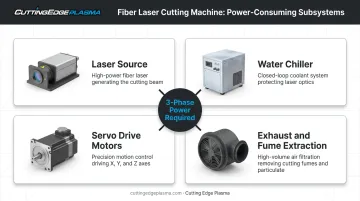
Single-phase power can't reliably sustain all of these simultaneously at commercial cutting power levels. That's why 3-phase service isn't a preference for most fiber laser installations — it's the baseline requirement.
Laser Output Power vs. Wall Power
Understanding your facility's actual electrical load starts with one distinction that catches many buyers off guard: the kW rating on a fiber laser refers to its optical output — the power delivered to the material being cut. It does not equal what the machine draws from the wall.
Efficiency figures from major laser source manufacturers illustrate the gap:
- IPG Photonics — high-power fiber lasers exceed 40% electro-optical efficiency; their YLS-ECO series tops 50%
- Raycus — measured greater than 37% conversion efficiency for 12kW and 20kW continuous fiber lasers
In practical terms, a 6kW fiber laser may draw 15kW or more from the facility for the laser source alone. Add the chiller, motion control, and extraction systems, and total facility draw climbs significantly higher.
Factors That Affect Real-World Electrical Draw
Published spec-sheet figures assume controlled conditions. Real shop environments add variables that push draws higher:
- Duty cycle: Multi-shift or near-continuous production sustains higher amperage draws than occasional cuts. Size your service for peak simultaneous load, not average load.
- Ambient temperature: Chillers work harder in warm environments or summer months, pulling more current than their rated draw under standard conditions.
- Component wear: Aging chillers and laser sources gradually draw more power over time. Build in headroom from the start — don't size your service panel to the spec sheet minimum.
Fiber Laser Power Requirements by Machine Wattage
Power requirements scale with laser wattage, and phase configuration is a hard constraint at most commercial power levels — not something that can be negotiated around with a heavier-gauge wire.
Single-Phase vs. 3-Phase Threshold
Lower-wattage machines — typically 1kW to 1.5kW — can generally operate on single-phase 220V service. This covers small-format machines suited to light fabrication or secondary cutting operations. Once you move to 2kW and above, 3-phase becomes the standard requirement across virtually all manufacturers.
Always verify against the specific machine's electrical specification sheet. The figures below represent general patterns, not universal specs.
Mid-Range and High-Power 3-Phase Requirements
| Laser Wattage | Approximate Service Type | Notes |
|---|---|---|
| 1kW–1.5kW | Single-phase 220V | Confirm with manufacturer; not universal |
| 2kW | 3-phase, 208V–480V | 3-phase required at this level |
| 3kW | 3-phase, 208V–480V | SENFENG HC Series lists 380V, 3-phase |
| 4kW | 3-phase, 208V–480V | Verify per machine spec sheet |
| 6kW | 3-phase, 208V–480V | SENFENG HC Series lists 380V, 3-phase |
| 12kW | 3-phase, 480V–600V | Dedicated panel, engineered conductor sizing required |
US shops typically work within 208V–480V 3-phase service. Many machines from global manufacturers list 380V 3-phase as their standard — your electrician will need to confirm compatibility with your utility supply or specify any transformation required.
Total System Draw: It's Not Just the Laser Source
This is where many shops underestimate their actual facility demand. According to SENFENG's comparison data, total electricity consumption across the full system is:
- 3kW fiber laser system: 14.4–23.4 kW total
- 6kW fiber laser system: 21.2–30.2 kW total
- 12kW fiber laser system: 48.9–62.1 kW total
Those totals reflect the full system — not just the laser source. EagleTec's component-level breakdown for a 4kW system shows exactly where the 33.5 kW goes:
- Laser source: 12 kW
- Auxiliary electronics: 10 kW
- Chiller: 6 kW
- Air compressor: 5.5 kW
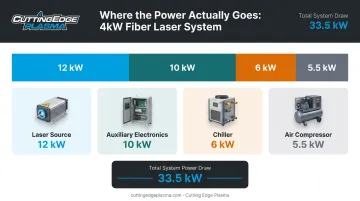
Laser source input + cooling load + motion systems + ancillary equipment = total facility demand. Plan your electrical service around that number, not the laser's optical output rating.
Rated values assume standard conditions — actual field load can vary. Obtain the full electrical specification document from your machine manufacturer before any electrical work begins.
Electrical Infrastructure Planning for Your Shop
Getting the machine is only part of the equation. The facility infrastructure has to be ready before it arrives.
Dedicated Circuit Requirements
A fiber laser should never share a circuit with other high-draw equipment. It needs:
- Its own dedicated breaker, correctly sized for full system load
- Correctly sized conductors (wire gauge) for the expected current and run length
- Proper grounding — Raycus's user documentation explicitly states that interruption of protective earth can result in personal injury
Sharing a circuit introduces voltage drop and interference that directly degrades cut quality and places stress on sensitive electronics.
Voltage Drop and Wire Run Length
Long wire runs from your panel to the machine increase resistance and reduce effective voltage at the machine — even if the panel voltage is correct. The NEC recommends limiting voltage drop to 3% on branch circuits (with a combined 5% maximum across feeder and branch circuit). Undersized or overly long runs can push a machine outside its operating voltage window, causing performance problems that look like machine faults but are actually infrastructure problems.
If your panel is far from the machine's installation location, this calculation matters. Have your electrician run it before finalizing conduit routing.
Utility Service and Licensed Electrician Requirements
3-phase service upgrades aren't just internal wiring projects. The utility company — not just your internal panel — determines whether 3-phase is available at your property. Bringing 3-phase to a facility that currently has only single-phase can involve:
- Utility design and engineering review (National Grid, for example, estimates 21 business days for design and up to 15 additional for engineering review)
- Line extension work, which is site-specific and varies by utility tariff
- Internal panel upgrades and permit pulls handled by a licensed electrician
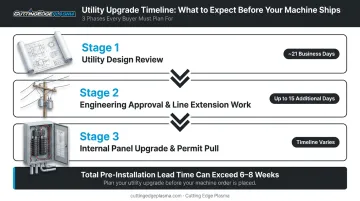
Start this conversation with your utility well before your machine ships. Lead times can surprise first-time industrial buyers.
Phase Converters: A Limited Option
For shops that can't access utility 3-phase, rotary phase converters can generate a simulated third phase from single-phase supply. However, there are real limitations:
- Static converters are not suitable for CNC equipment
- Rotary converters introduce power quality variables — phase imbalance and voltage variation — that can affect machine performance
- The DOE documents how voltage unbalance causes current imbalance, torque pulsations, vibration, and reduced insulation life in three-phase motors — all of which are present in laser chillers and servo drives
- No fiber laser OEM approval for phase converter operation was verified in available documentation
Before using a phase converter, confirm with the machine manufacturer that it's acceptable for your specific model and won't affect warranty coverage.
Power Quality Considerations
Voltage fluctuations, harmonics from neighboring equipment on the same service, and power surges can affect laser performance and shorten component life. Install a UPS or line conditioner if your facility runs welding equipment, heavy motors, or other high-draw machinery on the same service — these are the most common sources of interference that shorten laser component life.
For small shops or hobbyists where a 3-phase service upgrade is a real barrier, single-phase alternatives can bridge the gap. Cutting Edge Plasma's iPlasma XTREME CNC plasma tables run on dual-voltage single-phase power (110V/220V) across all table sizes — 4x4, 4x8, and 5x10 — so shops can start cutting metal productively without the upfront infrastructure cost of a fiber laser install.
Risks of Operating Outside the Required Power Envelope
Performance Degradation
Insufficient voltage or amperage causes the laser source to throttle output. In practice, that means:
- Inconsistent cut quality across the same material and thickness
- Incomplete penetration and excessive dross on cut edges
- Inability to maintain rated cutting speeds
- Results that look like a machine problem but trace back to the power supply
The machine runs — just not at its designed capability.
Component Damage and Accelerated Failure
Voltage instability and phase imbalance place thermal and electrical stress on the laser source, chiller motors, and servo drives. These are precision components with no built-in compensation for infrastructure shortfalls. Sustained operation outside the specified power envelope leads to premature failure and can void manufacturer warranties.
Maxphotonics's installation documentation explicitly requires that input AC voltage be normal mains voltage with a series circuit breaker in place — a baseline requirement, not a suggestion.
Safety and Compliance Risks
Operating high-power industrial equipment on an undersized or non-compliant electrical installation creates real fire risk. It also violates NEC 110.3(B), which ties installation to manufacturer instructions, and may conflict with OSHA 1910.303(b)(1), which requires electrical equipment to be free from recognized hazards.
Facility insurance coverage can be affected as well. Before commissioning any fiber laser system, confirm that your electrical installation meets both the manufacturer's specified requirements and applicable NEC and OSHA standards — not as a formality, but because non-compliance creates documented legal and financial exposure.
Common Misconceptions About Fiber Laser Power Requirements
"The laser is rated at 3kW, so I just need a 3kW circuit."
The kW rating is optical output for cutting, not electrical consumption. A 3kW fiber laser system typically draws 14.4–23.4 kW total from the facility once all subsystems are running. Circuit sizing must account for the full system draw as documented in the machine's electrical specification sheet.
"A phase converter is just as good as utility 3-phase."
Rotary phase converters can work in some applications, but they introduce power quality variables that utility 3-phase doesn't. Key risks to evaluate before going this route:
- Phase imbalance and voltage variation can affect cut quality and machine reliability
- DOE research documents measurable motor efficiency losses from phase imbalance on three-phase motors
- Some manufacturers won't support or warranty machines running on phase converters
Confirm with your machine's OEM before committing to a phase converter setup.
"My shop already has 220V, so I'm set for any fiber laser."
Single-phase 220V (common in residential and light commercial settings) and 3-phase 220V/240V are completely different service types. High voltage alone doesn't mean 3-phase capability. If you have a single 240V circuit from a residential-style panel, you don't have 3-phase — regardless of the voltage number.
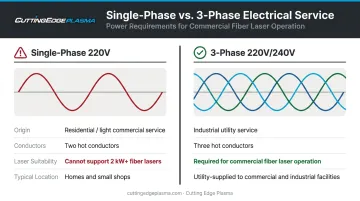
Verifying your actual service type before purchasing is the fastest way to avoid a costly surprise on installation day.
Frequently Asked Questions
How much power does a laser cutting machine use?
Total consumption varies by machine size and includes all subsystems. A 3kW fiber laser system may draw 14.4–23.4 kW total from the facility; a 12kW system can demand 48.9–62.1 kW. The laser's optical output rating accounts for only a portion of that total.
What power fiber laser do I need?
Match wattage to material thickness and production volume:
- Thin sheet (under 6mm): 1–3kW
- Medium plate (up to 20mm): 4–6kW
- Heavy plate: 8kW or above
Higher wattage also means stricter electrical infrastructure requirements — the two scale together.
Can a fiber laser cutting machine run on single-phase power?
Only lower-wattage machines — typically 1kW to 1.5kW — can operate on single-phase service. Machines at 2kW and above generally require 3-phase power. Attempting to run a higher-wattage machine on single-phase service will likely fail outright and risks damaging the equipment.
What amperage service do I need for a fiber laser cutter?
Amperage requirements scale with laser wattage and system configuration. Always use the machine's electrical specification sheet as the authoritative source; generic figures help with early planning, but the nameplate and manufacturer documentation are what actually govern your installation.
Do I need a dedicated circuit for a fiber laser cutter?
Yes. Sharing a circuit with other high-draw equipment causes voltage drop and interference that degrades cut quality and stresses components. The circuit must be sized for the full system load — laser source, chiller, motion control, and exhaust — not just the laser source rating alone.
What if my shop doesn't have 3-phase power available?
Start by contacting your utility company; upgrade timelines and costs vary by location. A rotary phase converter is an option if the machine manufacturer approves it. For shops with real infrastructure constraints, lower-wattage single-phase machines or alternative cutting technologies like CNC plasma tables may be the more practical near-term path.