Neglect the basics and the consequences stack up fast: degraded cut quality, unplanned downtime, expensive emergency repairs, and shortened machine life. None of those outcomes are inevitable — they're just what happens when maintenance gets treated as optional.
This guide covers why maintenance matters, the four main types, early warning signs to act on, and a practical scheduling framework you can put to work immediately.
Key Takeaways
- Consistent maintenance determines cut quality, uptime, and total machine lifespan
- Know your maintenance types: preventive, corrective, predictive, and overhaul each serve a distinct purpose
- Poor cut quality, unusual sounds, and cooling alerts are early warnings you shouldn't ignore
- Daily, weekly, monthly, and annual tasks each belong on a structured schedule
- Proactive maintenance costs a fraction of what reactive repairs will run you
Why Fiber Laser Cutting Machine Maintenance Matters
Fiber laser cutting equipment represents a serious capital commitment. Getting full value from that investment over time depends almost entirely on how consistently the machine is maintained.
The performance impact is measurable. Dirty optics shift beam focus. Under-lubricated rails introduce vibration. Degraded coolant raises operating temperatures. Each of these issues reduces cut precision and slows throughput, and they compound each other when left unaddressed.
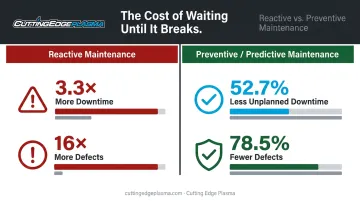
The broader manufacturing data supports this. NIST research on manufacturing machinery maintenance found that facilities relying more heavily on preventive and predictive maintenance experienced 52.7% less unplanned downtime and 78.5% fewer defects than those defaulting to reactive approaches. For a production shop running tight schedules, those numbers translate directly to capacity and margin.
The Cost of Reactive Maintenance
Reactive maintenance — waiting until something breaks — is the more expensive path. Consider what an unplanned failure actually costs:
- Emergency parts orders at premium pricing
- Rush freight or expedited technician visits
- Lost production hours while the machine sits idle
- Potential collateral damage to adjacent components
Deloitte estimates that poor maintenance strategies can reduce productive capacity by 5% to 20%, with unplanned downtime costing industries roughly $50 billion annually. For an individual shop, even a single multi-day breakdown can wipe out weeks of margin.
Consumable degradation compounds those losses. Nozzles and protective lenses that should last weeks get destroyed in days when upstream optics are dirty. Guide rails that should run smoothly for years wear prematurely when lubrication is inconsistent. The replacement parts cost money, but the hours of lost cutting time cost more.
Types of Fiber Laser Cutting Machine Maintenance
Effective machine care isn't one-size-fits-all. Four distinct maintenance types exist, and high-performing shops typically use all of them in combination.
Routine / Preventive Maintenance
Preventive maintenance is scheduled, time-based upkeep designed to stop problems before they start. Typical tasks include:
- Cleaning protective lenses and nozzles after each use
- Lubricating X, Y, and Z axis rails on a regular schedule
- Checking coolant levels and air pressure daily
- Inspecting the cutting table surface and removing slag buildup
- Monitoring assist gas pressure and quality
Preventive maintenance works well in low-to-moderate use environments with controlled operating conditions. It's also the most cost-effective option — protective windows for common fiber laser systems range from roughly $30 to $288 depending on the model and size, making regular replacement far cheaper than the downstream damage a failed window causes to the focus lens.
Corrective / Reactive Maintenance
Corrective maintenance addresses failures after they've already occurred — replacing a burned nozzle mid-job, fixing a rail misalignment after a crash, or resolving error codes during operation.
Some reactive maintenance is unavoidable. What's problematic is relying on it as the primary strategy. NIST data shows that the top 25% of facilities by reactive maintenance use experienced 3.3 times more downtime and 16 times more defects than those in the bottom 25%. Frequent reactive repairs usually indicate a gap in the preventive routine — not just bad luck.
Predictive / Condition-Based Maintenance
Predictive maintenance monitors specific performance indicators — coolant temperature trends, power output readings, vibration levels — to anticipate failures before they occur. It's more common in high-volume or multi-shift production environments where downtime carries a steep per-hour cost.
The upfront investment in sensors and data logging software pays off. NIST found that facilities with stronger predictive maintenance programs had 87% lower defect rates and 15% less downtime compared to those relying primarily on preventive schedules alone.
Major / Overhaul Maintenance
Overhaul maintenance is deep-level servicing performed at long intervals. This includes:
- Full X/Y axis alignment and perpendicularity checks
- Laser source diagnostics
- Drive system inspection
- Replacement of high-wear structural components
Overhaul service requires a certified technician and carries the highest one-time cost. Bystronic recommends annual professional servicing, recalibration, and software updates as the standard cadence. After any significant mechanical event — a crash, collision, or hard stop — schedule an overhaul inspection before resuming production.
Warning Signs Your Fiber Laser Cutting Machine Needs Maintenance
Recognizing these warning signs early keeps small problems from turning into costly downtime or component failures.
Degraded Cut Quality
Cut quality is usually the first thing operators notice when something is off. Watch for:
- Rough or jagged edges that were previously clean
- Incomplete cuts or incomplete pierce-throughs
- Burn marks on the material surface
- Inconsistent cutting speeds across the same material
Mazak identifies loss of cut, reduced cutting speeds, and deteriorating cut quality as direct indicators that the protective window needs attention. The protective window sits between the nozzle and focus lens and acts as a sacrificial barrier — when it's compromised, contamination can reach the focus lens and trigger far more expensive repairs.
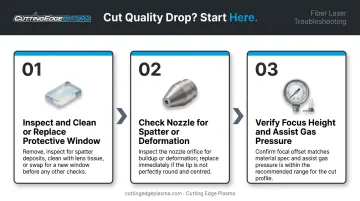
When cut quality drops, start here before assuming a deeper mechanical issue:
- Inspect and clean (or replace) the protective window
- Check the nozzle for spatter or deformation
- Verify focus height and assist gas pressure settings
Unusual Mechanical Behavior
Abnormal sounds during axis movement are worth investigating immediately — each one points to a specific failure area:
- Grinding on the X or Y axis usually means the rack and pinion needs lubrication
- Squealing during rail travel signals poor guideway lubrication or misalignment
- Clicking or irregular movement often points to loose components or debris in the rail system
Bystronic's maintenance guidance specifically calls out monitoring for unusual noise or resistance during motion as part of routine inspection. Unexpected shutdowns, axis errors, or failure to home properly typically point to sensor issues, wiring faults, or drive system problems — diagnose and resolve these before restarting the machine.
Cooling and Electrical Alerts
Cooling system warning signs:
- Overheating alarms or coolant temperature fluctuations
- Reduced water flow (chiller flow alarms indicate flow has dropped below threshold)
- Visible coolant discoloration or debris in the system
Common causes include low coolant levels, clogged filters, or a failing pump. TEYU recommends replacing cooling water quarterly with distilled or purified water to maintain proper conductivity and prevent buildup.
Electrical issues tend to show up on the control panel first, but the underlying causes range from wiring wear to voltage instability:
Electrical warning signs:
- Error codes on the control panel that repeat or escalate
- Unstable voltage readings
- Wiring showing discoloration or looseness
Electrical faults should never be bypassed — they create both machine damage risk and real safety hazards for operators.
Fiber Laser Cutting Machine Maintenance Schedule
Maintenance frequency depends on how hard the machine works. A machine running two shifts daily needs more attention than one used a few hours per week. The environment matters too — dusty fabrication shops accelerate contamination of optics and filters compared to cleaner production settings.
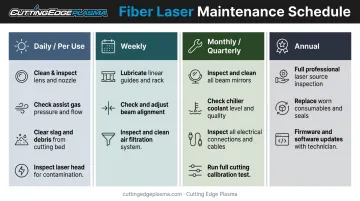
Use this table as your baseline framework:
| Interval | Key Tasks |
|---|---|
| Daily / Per Use | Clean cutting table, remove slag and debris; inspect and clean protective lens; check coolant levels and air pressure; inspect nozzle for wear or residue; check before and after each job when cutting problematic materials |
| Weekly | Lubricate X, Y, and Z axis guide rails and rack-and-pinion systems; drain air compressor tank; inspect water hoses and electrical cables; check chiller flow rate and coolant conductivity |
| Monthly / Quarterly | Replace air and cooling system filters; test emergency shutoffs; verify X/Y axis alignment tolerance; inspect belt drives and gear systems; replace cooling water with distilled/purified water |
| Annual | Full machine calibration by a certified technician; laser source diagnostic test; comprehensive inspection and replacement of high-wear parts; complete safety and electrical audit; software updates |
Scheduling Notes for High-Usage Environments
If your machine runs continuous multi-shift operations, compress the schedule:
- Move weekly tasks to every 2–3 days
- Move monthly tasks to every 3–4 weeks
- Treat the protective window as a per-job inspection item for any difficult materials
Log every maintenance action with the date, task performed, and technician notes. This record supports warranty claims, helps identify recurring issues before they escalate, and gives any service technician a useful baseline when something goes wrong.
Cutting Edge Plasma includes lifetime technical support with every machine — direct access to the team that knows your equipment, which makes sticking to a schedule and catching early warning signs considerably easier.
Frequently Asked Questions
What maintenance does a fiber laser cutting machine need?
Core maintenance includes daily protective lens cleaning, table cleanup, nozzle inspection, and coolant checks; weekly rail lubrication and filter monitoring; and periodic professional calibration. All of it should follow a consistent, documented schedule tied to your machine's actual usage levels.
How often should a fiber laser cutting machine be serviced?
Basic tasks run daily and weekly. Filter replacements and alignment checks happen monthly to quarterly. Full professional servicing (calibration, laser diagnostics, comprehensive inspection) should happen annually at minimum, with higher frequency for machines running multiple shifts.
What is the lifespan of a fiber laser cutting machine?
IPG Photonics rates fiber laser diodes at over 100,000 hours of expected life under normal operating conditions. Overall machine lifespan depends heavily on maintenance quality — well-maintained machines deliver years of reliable production, while neglected ones fail significantly earlier.
What are the most common fiber laser cutting machine problems?
The most common issues are poor cut quality from dirty optics or worn nozzles, axis movement errors from insufficient lubrication, overheating from coolant system neglect, and control panel error codes from electrical or sensor faults. Routine maintenance prevents most of them.
How do I clean fiber laser cutting machine lenses properly?
First, blow loose debris off with filtered air or dry nitrogen. Then apply optical-grade isopropyl alcohol to a lint-free cotton swab or lens tissue and wipe in one direction without scrubbing. Wear clean cotton or nitrile gloves throughout. Inspect for coating damage before reinstalling; replace immediately if scratched.
What happens if a fiber laser cutting machine is not maintained?
Cut quality declines, breakdowns become more frequent, consumable life shortens, and repair costs escalate. Over time, neglected maintenance leads to premature failure of critical components like the laser source and drive system, which are costly and slow to replace.