This guide covers the tube shapes laser machines can process, compatible materials and their requirements, what must never be cut, and how to match your tube selection to your actual project needs.
Key Takeaways
- Laser tube cutters handle round, square, rectangular, oval, and open-section profiles — verify chuck compatibility before ordering
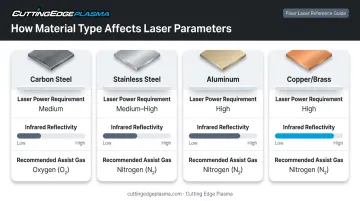
- Compatible metals include carbon steel, stainless steel, aluminum, copper/brass, and titanium — power levels and assist gases vary by material
- Never laser cut PVC, ABS, carbon fiber composites, or most plastics — toxic fumes and equipment damage result
- Wall thickness, tube diameter, and laser power determine whether any given cut is achievable
- For thick structural steel where laser precision isn't required, CNC plasma cutting delivers strong cost-per-cut economics
What Is Laser Tube Cutting, and Why Does Tube Type Matter?
Laser tube cutting is a CNC-controlled process where a focused fiber laser beam cuts through the wall of a metal tube or profile. A rotary chuck system holds the workpiece, rotates it against the cutting head, and software coordinates the movement to produce slots, holes, angled ends, and complex contours in a single setup.
Tube type matters for two reasons:
Shape drives machine configuration. Different profiles require different chuck systems and cutting paths. Round tubes rotate uniformly; square tubes must index flat faces; open sections like angle steel require collision-avoidance logic (programming that keeps the cutting head from striking the workpiece).
Material determines laser parameters. Different metals absorb laser energy at different rates. According to IPG Photonics, aluminum and copper have high infrared reflectivity and require higher power densities than steel — so identical machine settings will produce very different results depending on what's loaded in the chuck. Running the wrong parameters risks damaged lenses, contaminated optics, or hazardous fumes.
What Tube Shapes Can a Laser Cutting Machine Cut?
Modern laser tube cutters are not limited to round pipe. They can process a broad range of profiles — from standard geometric shapes to structural sections — as long as the machine's chuck system supports the geometry.
Round Tubes
Round tubes are the most common profile and the easiest to process. The rotating chuck grips and spins the tube uniformly, allowing precise circular cuts, angled ends, slots, and holes without interruption.
Diameter ranges vary significantly by machine class:
- Entry-level systems (such as BLM's LT5.10): up to 120mm diameter
- Mid-range systems (such as TRUMPF TruLaser Tube 7000): up to 273mm diameter
- Heavy-duty industrial systems (BLM Lasertube range): up to 610mm / 24 inches
- QLTEK L SERIES (available through Cutting Edge Plasma): round tube from 0.31" up to 20" diameter, with power options from 1.5kW to 20kW
Common applications include pipelines, furniture legs, exhaust systems, fitness equipment frames, and medical equipment — anywhere consistent geometry and high-volume repeatability matter.
Square and Rectangular Tubes
Square and rectangular profiles require a four-jaw chuck or self-centering system that grips corners and indexes each flat face as the tube rotates. The TRUMPF TruLaser Tube 7000, for example, handles square tubes up to 203 × 203mm and rectangular tubes up to 254mm on the long side.
These profiles are widely used in:
- Machine frames and warehouse racking
- Structural columns and trusses
- Furniture and shelving systems
- Automotive and trailer frames
One practical limitation: very thin-walled square tubes can deform at corners if cutting parameters aren't dialed in. Machines with automatic force-controlled chucking — where jaw pressure adjusts based on wall thickness — prevent this deformation without operator intervention.
Oval and Elliptical Tubes
Oval and elliptical profiles appear frequently in fitness equipment, decorative structures, and automotive exhaust systems. The challenge is that the machine software must account for the continuously varying radius as the chuck rotates.
Common applications include:
- Fitness equipment frames and handlebars
- Decorative architectural elements
- Automotive exhaust and intake components
Not all entry-level tube lasers support these profiles. Bystronic's tube laser systems include fully automatic setup that adapts to elliptical profiles — but confirm this capability against a specific machine model before quoting jobs with non-circular closed sections.
Open-Section Profiles (Angle Steel, Channel Steel, C/U Sections)
Open sections — L-shaped angle steel, C-channel, U-channel — are structurally different from closed tubes. The cutting head must navigate the open face without collision while maintaining consistent focal distance from the material surface.
Bystronic's ByTube Star 330 explicitly lists C, H, I, and L profiles among its supported geometries. BLM's Active Scan technology corrects cutting paths based on the actual geometry of the loaded profile, which is particularly useful for angle and channel stock that may have dimensional variation.
Best-fit applications include:
- Brackets and mounting plates
- Conveyor frames and support structures
- Trusses and roof framing components
- Any part where the open-profile geometry is functional, not incidental
Structural Profiles (H-Beams, I-Beams)
H-beams and I-beams represent the most complex profiles for laser tube systems. The cutting head must navigate flanges and webs while maintaining consistent focal positioning throughout the cut path.
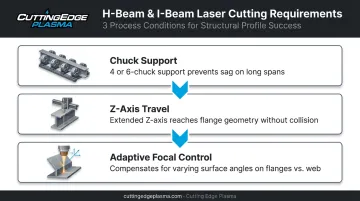
Processing these profiles typically requires:
- Four-chuck or six-chuck support systems to prevent sag across long spans
- Extended Z-axis travel to reach into flange geometry without collision
- Adaptive focal control to compensate for the varying surface angles of flanges versus the web
H and I-beam cutting is best suited for structural fabrication — connection plates, beam cope cuts, bolt-hole patterns, and end-preparation work that would otherwise require saw cutting followed by manual drilling. Confirming beam size limits against your specific machine's chuck capacity and Z-axis travel is essential before processing these profiles.