Introduction
Fiber laser cutting has become one of the most versatile precision technologies in modern manufacturing, serving industries from aerospace to artisan jewelry with a single, highly adaptable process. Today it runs in automotive plants, medical device shops, architectural studios, and small fabrication shops across the country.
That reach keeps expanding, driven by cutting speed on thin-to-mid gauge metals, minimal material waste, and the ability to handle reflective metals that CO2 lasers struggle with. According to a 2024 MarketsandMarkets report, the global fiber laser market is projected to grow from $7.7 billion in 2024 to $12.8 billion by 2029 at a 10.8% CAGR — growth spread across dozens of industries, not concentrated in any single sector.
This guide covers 27 real-world applications with concrete examples organized by sector, so fabricators, shop owners, and engineers can quickly identify where fiber laser cutting fits their work.
Key Takeaways
- Fiber laser cutting uses a focused beam delivered via fiber optic cable to cut metals with minimal heat distortion and high repeatability
- Applications span 27+ industries — from automotive body panels and aerospace titanium to jewelry and architectural facades
- Reflective metals — copper, brass, and aluminum — are where fiber lasers outperform CO2 systems most decisively
- High-power systems (10kW–30kW+) cut carbon steel plates exceeding 50mm, competing with plasma on thick material
- Entry-level fiber laser systems start around $54,000 — making machine selection a key decision for shops scaling up from plasma
What Is Fiber Laser Cutting and How Does It Work?
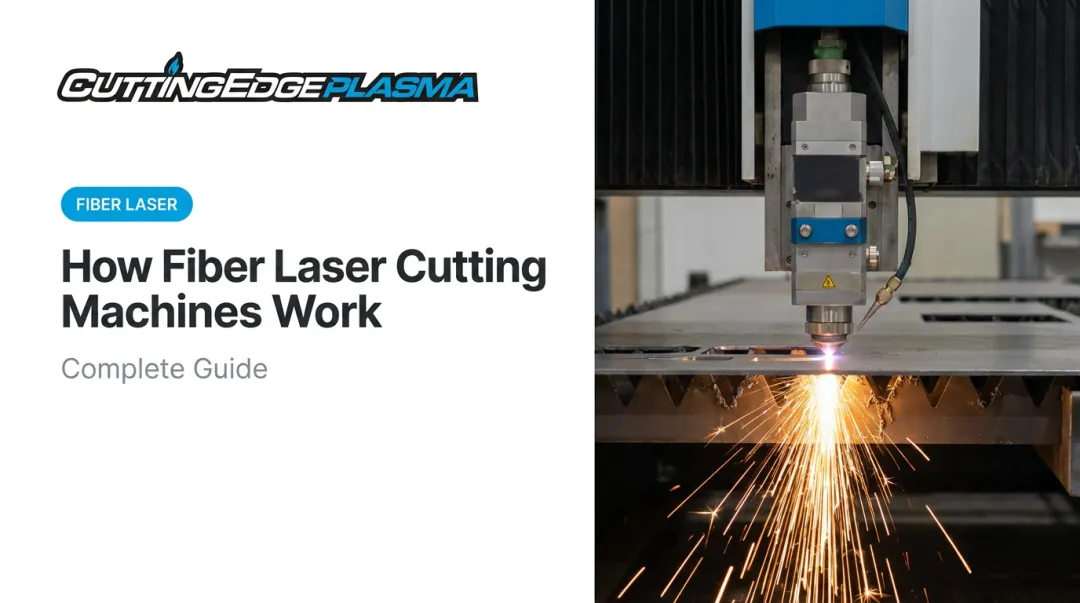
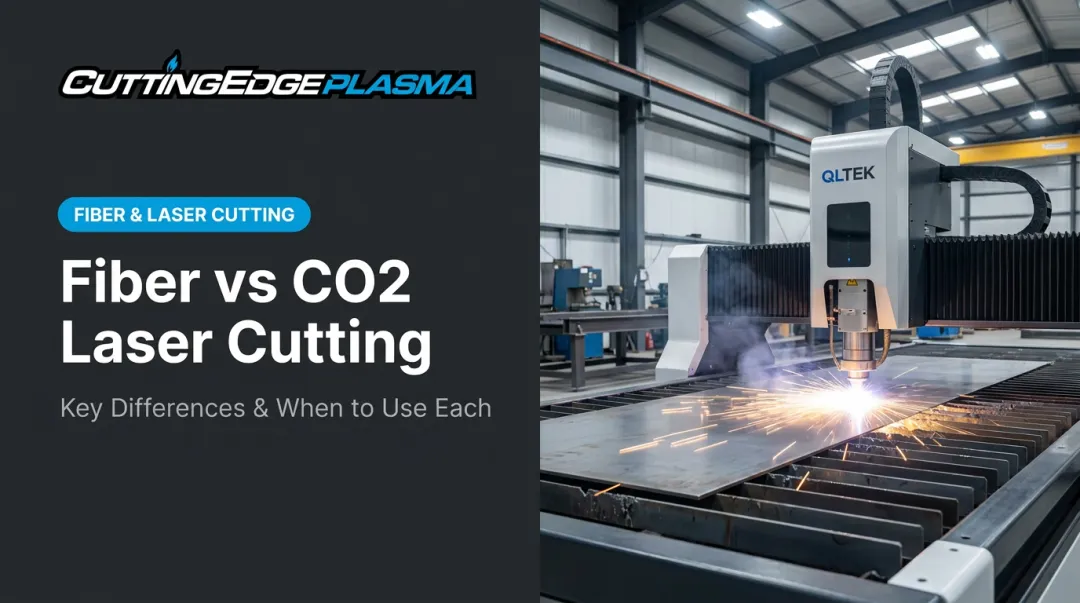
Fiber laser cutting generates its beam using diode-pumped active fiber optic cables, producing a wavelength of approximately 1,070 nm. As The Fabricator has reported, most common fabrication metals absorb more energy and reflect less light at the 1-micron wavelength than at the 10.6-micron wavelength produced by CO2 lasers. This translates directly to faster cutting speeds, lower energy consumption, and stronger performance on reflective metals like copper, brass, and aluminum.
The Cutting Process
The focused beam melts or vaporizes material at the cut point. An assist gas — nitrogen, oxygen, or air depending on the material — simultaneously expels molten material and protects the cut edge. The outcome is a narrow, clean kerf with minimal burrs and a tight heat-affected zone.
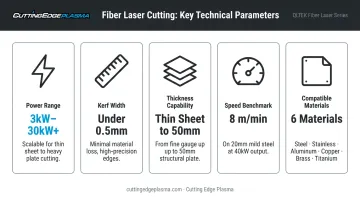
Key technical parameters:
- Power range: 3kW to 30kW+ in industrial systems (Bystronic's ByCut series, for example, offers 3–30kW configurations)
- Kerf width: Under 0.5mm at standard settings
- Thickness capability: From thin sheet metal at high speed to 50mm plate on high-power systems
- Speed benchmark: A 40kW fiber laser cuts 20mm mild steel at approximately 8 m/min, per IPG Photonics
- Material advantage: Handles steel, stainless steel, aluminum, copper, brass, and titanium — including reflective metals that cause back-reflection problems for CO2 systems
Heavy Industry and Manufacturing Applications (Uses 1–9)
Use 1: Automotive Manufacturing
Fiber laser cutting produces body panels, chassis components, engine mounts, exhaust parts, and EV battery trays. The non-contact process prevents material deformation, which matters in high-tolerance assemblies where a bent door reinforcement or miscut seat bracket creates downstream problems.
The EV sector is a major demand driver. TRUMPF documents laser cutting as part of the process for creating gas-tight battery trays, and Grand View Research confirms that EV and battery manufacturing is driving fiber laser adoption across the automotive supply chain.
Use 2: Aerospace
Aerospace relies on fiber lasers to cut titanium alloys, high-strength aluminum, and heat-resistant superalloys used in engine components, fuselage panels, and landing gear assemblies. Bystronic notes that laser cutting aerospace-grade titanium sheets reduces weight, improves performance, and lowers production costs.
Xometry confirms fiber laser-cut titanium is standard for lightweight, durable aerospace parts. The tight tolerance requirements of aerospace manufacturing mean fiber laser outperforms plasma for many precision components.
Use 3: Shipbuilding and Marine
Fiber laser cutting handles the thick steel plates used in hull construction, precision fittings, and marine-grade stainless components. Consistent laser-cut edges reduce secondary finishing on structural parts exposed to saltwater, since marine welds and joints depend on edge quality for corrosion resistance.
Marine applications typically include:
- Hull plating and structural frame sections
- Precision pipe fittings and flange blanks
- Marine-grade stainless components for deck hardware and enclosures
Use 4: Defense and Military
Military applications include vehicle armor plating components, precision weapon system hardware, and protective gear elements. The U.S. Army's procurement of CNC fiber laser systems, including a documented contract for delivery, installation, and training at Letterkenny Army Depot, reflects how mission-critical repeatability on high-hardness alloys makes fiber laser the preferred process.
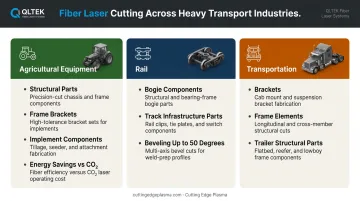
Use 5: Agricultural, Rail, and Transportation Machinery
Three connected industries share a common production need: high-volume, durable metal components.
- Agricultural equipment: Tractor and harvester structural parts, frame brackets, and implement components — Bystronic confirms that a single fiber laser requires the same energy as two CO2 lasers, reducing operating costs in high-volume ag equipment production
- Rail: Precision bogie components and track infrastructure parts — Messer's rail systems offer fiber laser beveling up to 50 degrees for complex rail profiles
- Transportation: Laser-cut brackets, frame elements, and trailer structural parts for trucking and logistics equipment
Use 6: Energy Sector — Conventional and Renewable
Conventional energy applications include pipeline components, valve bodies, and pressure vessel parts. On the renewable side, AMG Industries confirms running fiber laser cutting for solar component blanks: racking sections, mounting bracket pre-forms, and ground-mount steel plates. Wind turbine tower flanges and EV charging station structural parts also fall into this category.
Use 7: Heavy Equipment and Thick-Plate Applications
Manufacturers producing excavator booms, loader buckets, and crane components rely on thick-plate cutting capability. Bystronic's high-power systems can cut carbon steel with up to 30kW laser power at thicknesses up to 50mm. That capability replaces slower plasma processes where tighter tolerances matter more than raw cut speed.
Uses 8–9: Tool, Die, and Mold / Packaging and Food Processing Equipment
Tool and die: Laser cutting accelerates mold insert production and die template fabrication. TRUMPF confirms its lasers produce tools and molds with precision while supporting repairs on worn tooling that previously took weeks.
Food processing: Custom Conveyor documents a 3kW fiber laser for precise cutting of stainless sheet stock in food processing equipment. Laser cutting's burr-free finish reduces sanitation risk compared to mechanical cutting methods, a meaningful factor under NSF food equipment standards.
Technology, Electronics, and Precision Applications (Uses 10–16)
Use 10: Electronics and PCB Manufacturing
Fiber lasers cut printed circuit boards, semiconductor lead frames, and smartphone structural components — SIM trays, antenna slots, and mid-frames — with micron-level accuracy. The minimal heat-affected zone is essential here.
Thermal damage to traces or substrate layers compromises electrical performance on components where tolerances are measured in fractions of a millimeter. Coherent's fiber lasers are confirmed for processing challenging materials common in electronics manufacturing:
- Copper and copper alloys
- High-strength steel
- Aluminum sheet and foil
- Thin-gauge specialty foils
Use 11: Medical Device Manufacturing
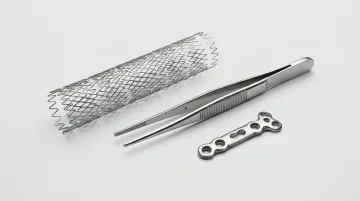
Medical-grade components demand both precision and cleanliness — two areas where fiber laser cutting excels. Common laser-cut devices include:
- Surgical instruments: scalpels, forceps, retractors
- Orthopedic implants: bone plates and joint components
- Cardiovascular devices: stents, catheter shafts, hypotubes, PTCA and TAVR components
All are cut from titanium alloys or medical-grade stainless steel. IPG's Versa Small Tube Cutter targets stent machining and small medical tubes specifically; Coherent's StarCut Tube handles the catheter and TAVR side.
The non-contact process prevents surface contamination during cutting. Medical device manufacturers must comply with ISO 13485:2016 quality management standards, which the FDA's QMSR incorporates by reference — so process documentation and cut repeatability are regulatory requirements, not just best practices.
Use 12: Research, Development, and Rapid Prototyping
R&D engineers use fiber lasers to iterate quickly — loading a revised CAD file and cutting a new prototype enclosure, test bracket, or custom fixture within minutes. No tooling changes. No outsourcing lead times. For product development teams running multiple design iterations per week, that turnaround compresses weeks of traditional lead time into a single day.
Uses 13–14: Gaskets and Precision Instrumentation
Gaskets and sealing: Laser cutting produces exact-dimension rubber and composite gaskets for automotive, industrial, and HVAC applications. The non-contact process prevents the tearing and deformation that die-cutting causes on thin or soft materials.
Precision instrumentation: Scientific instruments, optical mounts, and laboratory equipment housings require the same micron-level tolerances as medical devices — fiber laser delivers these without secondary machining on most components.
Construction, Design, and Creative Applications (Uses 17–23)
Construction, Design, and Creative Applications (Uses 17–20)
Use 17: Architectural and Construction Industry
Modern architecture uses laser-cut steel and aluminum for structural facades, ornamental curtain walls, decorative grilles, and sunshades. Large-format panels can be perforated in geometric patterns at a scale and density that conventional punching can't match.
Real-world examples show the range of applications:
- Zahner uses computer-programmed perforation and embossing in their architectural facade systems
- AMICO Architectural Metals documents interior screen projects where the pattern complexity rules out conventional tooling
Use 18: Furniture and Interior Design
Custom metal furniture components — table frames, cabinet hardware, decorative legs, and interior screens — are produced using laser cutting. The precision allows designers to execute complex patterns in steel, brass, or hardwood that align exactly with digital CAD designs.
For purely wood-focused runs, CNC routers are typically paired alongside laser cutting, with each machine handling the materials it processes most efficiently.
Use 19: Art, Sculpture, Signage, and Advertising
Three creative industries converge here:
- Artists produce metal sculptures with precision-cut interlocking components — multi-piece steel wall installations assembled without welding
- Sign makers rely on fiber lasers for backlit aluminum lettering, intricate stainless steel logos, and detailed wayfinding panels — a dimensional brand logo cut in 3mm aluminum is a common application
- Advertising and events use laser-cut promotional displays and trade show booth elements where customization and short lead times are both required
Use 20: Jewelry and Fashion
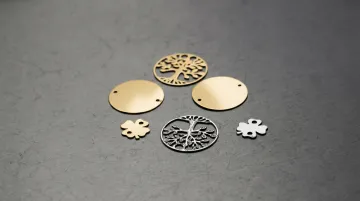
LaserStar confirms that fiber laser cutting is emerging as a leading choice for jewelry production — offering higher power output, lower maintenance requirements, and cleaner edge quality on precious metals than CO2 alternatives. Han's Laser documents its fiber cutter for gold, silver, and stainless steel plate cutting in jewelry applications.
The key advantage is repeatability: small-batch runs of identical pieces in gold or silver, where even slight dimensional variation is unacceptable. The same precision applies to the fashion industry — laser-cut metal hardware on accessories, belt buckles, and garment embellishments benefits from the same tight tolerances.
Other Notable Industry Applications (Uses 21–27)
Use 21–22: Sports Equipment and Stage/Event Design
Sports equipment manufacturers use laser cutting for custom metal components in cycling, motorsports helmets, and fitness equipment frames. Event and stage production companies laser-cut structural elements, decorative set pieces, and branded props — where the technology's speed matches the tight deadlines of production cycles.
Use 23: Rubber, Gaskets, and Sealing Components
The gasket and sealing industry uses laser cutting for exact-dimension rubber and composite seals used in automotive, industrial, and HVAC systems. An undersized gasket leaks; an oversized one won't seat correctly. There's no margin for error.
Use 24–25: Defense R&D and Scientific Research
Defense contractors and national laboratories use fiber lasers for classified component development, prototype weapons system parts, and materials research. The ability to cut exotic alloys — beryllium copper, Inconel, Hastelloy — without the contact contamination introduced by tooling or coolant in conventional machining makes laser the preferred process for these environments.
Use 26: Education and Maker Spaces
Educational institutions and maker spaces use fiber laser cutting for student engineering projects, research prototypes, and custom fixtures. Common applications include:
- Structural test components for mechanical engineering coursework
- Research-grade prototypes where repeatable tolerances matter
- Custom fixturing for lab equipment and academic fabrication labs
This segment is steadily expanding fiber laser adoption into environments where hands-on CNC training was once limited to plasma or router-based machines.
Use 27: HVAC and Building Systems
HVAC manufacturers use laser-cut stainless and galvanized steel components for ductwork fittings, dampers, and custom housing assemblies. The burr-free finish and dimensional accuracy of laser cutting translates directly to tighter seals and reduced assembly time.
Conclusion
Fiber laser cutting spans an extraordinary range: titanium aerospace components at one end, custom jewelry at the other. Across more than 27 industries, the technology has moved from industrial specialty to standard shop capability.
For fabricators and small shop owners, the practical question is finding the right CNC cutting technology for your specific materials, budgets, and production volumes. Fiber laser excels at precision metal cutting, particularly on thin-to-mid gauge sheet. But for shops working primarily with steel and aluminum on custom fabrication or small-batch production, CNC plasma cutting remains the most accessible and cost-effective entry point — delivering real precision without enterprise-level investment.
Cutting Edge Plasma has been building toward that market since 2014. Their iPlasma XTREME series pairs with Hypertherm plasma cutters and includes lifetime technical support, so fabricators and small shops can bring complex cuts in-house without the overhead of a large industrial operation.
To find the right CNC cutting solution for your shop, call Cutting Edge Plasma at (952) 500-3353, Monday through Friday, 9 AM–5 PM, or visit their website to explore the full product line.
Frequently Asked Questions
What are the applications of fiber laser cutting machines?
Fiber laser cutting machines are used across automotive, aerospace, medical devices, electronics, construction, signage, jewelry, and more. Any application requiring clean, repeatable metal cuts — whether high-volume production or small-batch custom work — suits fiber laser well.
What materials can a fiber laser cut?
Primary materials include mild steel, stainless steel, aluminum, copper, brass, and titanium. Fiber lasers are especially effective on reflective metals where CO2 lasers struggle. They are less suited for non-metals like wood or acrylic, where CO2 or CNC routers are better choices.
How does fiber laser cutting differ from plasma cutting?
Fiber lasers offer higher precision with kerf widths under 0.5mm — ideal for intricate parts and thin materials. CNC plasma cutting is faster on thicker steel, significantly lower in upfront cost, and well-suited for structural fabrication and larger part production where micron-level tolerances aren't required.
What industries use fiber laser cutting the most?
Automotive, aerospace, electronics, and general metal fabrication represent the highest-volume adopters. Medical device manufacturing and renewable energy infrastructure are among the fastest-growing application areas, driven by tight tolerances and expanding production volumes.
Can small businesses benefit from fiber laser cutting?
Small shops can benefit from bringing complex cuts in-house and reducing outsourcing costs. That said, upfront machine costs are higher than plasma systems, and ROI depends heavily on production volume and material mix. For many small shops, CNC plasma is the more practical starting point.
What thickness of metal can a fiber laser typically cut?
Cutting thickness depends on laser power. Lower-power machines (1–3kW) handle thin sheet metal under 10mm efficiently. High-power systems (10kW+) can cut carbon steel plates over 30mm, with 30kW machines reaching 50mm in some configurations, though speed drops considerably as thickness increases.