Pick the wrong machine for your work mix and you'll feel it: bottlenecks on complex orders, ballooning tooling costs, secondary operations that eat into margins, or a cutting system that simply can't keep pace with volume. The stakes are high enough that this decision deserves a thorough breakdown.
This guide covers how each technology works, a direct side-by-side comparison across key operational factors, and a situational framework to help fabricators, shop owners, and first-time CNC buyers identify the right fit — including a third option for those who don't need to drop six figures to get started.
Key Takeaways
- Fiber lasers handle complex geometry and diverse materials without tooling changes , making them the stronger choice for varied job types and tight-tolerance work.
- CNC punch presses dominate hole-intensive, high-volume runs and can form features (louvers, countersinks) in a single pass.
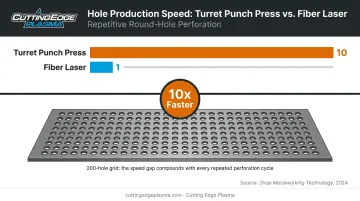
- Punch presses are reportedly 10x faster than lasers for round-hole perforations on high-volume parts.
- Total cost of ownership depends heavily on production mix, not just purchase price.
- For smaller shops or hobbyists, CNC plasma cutting offers a lower entry point — typically under $20,000 — compared to $54,000+ for fiber laser systems.
Fiber Laser vs CNC Punch Press: Quick Comparison
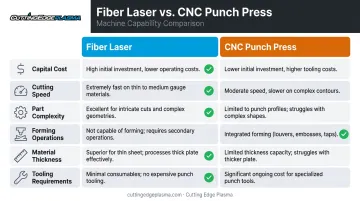
Use this table to see at a glance where each machine wins — and where its limitations start.
| Factor | Fiber Laser | CNC Punch Press |
|---|---|---|
| Capital Cost | $54,000–$134,900+ depending on power and brand | RFQ-driven; request quotes from dealers |
| Cutting Speed | Faster for complex contours and thin sheet profiling | Up to 10x faster for repetitive round-hole production |
| Part Complexity | Virtually unlimited geometry, no tool changes | Best for standard shapes; dedicated tooling per feature |
| Forming Operations | Cannot form — requires a separate machine | Punches, forms, and taps in a single operation |
| Material Thickness | Up to 60mm (24kW); 25mm at 6kW | Typically ¼" (6mm) maximum |
| Tooling Requirements | None | Required per feature type; ongoing inventory cost |
What Is a Fiber Laser?
A fiber laser cutter delivers a high-power beam through fiber optic cable, using assist gases (oxygen, nitrogen, or air) to melt or vaporize metal. The sheet stays stationary while the laser head moves across X, Y, and Z axes. The laser head never touches the material.
Core Advantages
- Burr-free edges that reduce or eliminate post-processing time
- Zero tooling — no changeovers, no tool inventory management
- Tight tolerances for precision-critical parts
- Minimal heat-affected zone, reducing material distortion on thin sheet
A single fiber laser processes stainless steel, mild steel, aluminum, copper, brass, and titanium — no machine swap required. For job shops fielding diverse customer orders, that flexibility directly cuts setup time and scheduling complexity.
Thickness Capability
Manufacturer specs from TRUMPF's 2025 TruLaser brochure illustrate the range:
- 6kW: up to 25mm mild steel, 25mm stainless, 20mm aluminum
- 12kW: up to 35mm mild steel, 50mm stainless (with package), 30mm aluminum
- 24kW: up to 60mm across mild steel, stainless, and aluminum
For most job shop applications, a 6kW system covers the vast majority of sheet metal work encountered in practice.
Those capabilities come with real trade-offs, though.
Where Fiber Lasers Fall Short
- Cannot perform forming operations — louvers, embossments, and extrusions require a separate press
- Higher initial acquisition cost than punch presses for equivalent throughput on simple parts
- Ongoing costs for assist gases, optics maintenance, and chiller systems add to operating overhead
Fiber Laser Use Cases
Fiber lasers fit best where flexibility and precision outweigh raw hole-punching speed:
- Job shops handling diverse customer orders with frequent design changes
- Contract manufacturers where part geometry shifts between runs
- Architectural metalwork and custom enclosures requiring intricate contours
- Aerospace, medical device, and electronics manufacturing — sectors where tight tolerances are non-negotiable
According to Allied Market Research, the global fiber laser market stood at $3.3 billion in 2022 and is projected to reach $9.2 billion by 2032 — a signal of how broadly this technology is being adopted across manufacturing sectors.
What Is a CNC Punch Press?
A CNC punch press uses a rotating turret loaded with punch-and-die combinations to mechanically shear holes and form features into sheet metal. Unlike a laser where the head moves, here the sheet travels in X and Y while the punch head stays fixed, striking the material at high stroke rates.
Core Advantages
- Exceptional hole production speed : each hole takes a single stroke vs. a laser tracing the full circumference
- In-operation forming : louvers, bridges, countersinks, embossments, and tapped holes in the same program run
- No assist gas requirement, eliminating one of the laser's primary operating cost drivers
- Consistent repeatability on established tooling sets for high-volume parts
The speed advantage for hole-intensive work is substantial. Shop Metalworking Technology reported in 2024 that for round-hole perforations, a turret punch press can operate at 10x the speed of a laser. For a part with 200 identical holes per sheet, that gap compounds across every production run.
Limitations Worth Knowing
- Maximum punchable thickness is typically ¼" (6mm) — thicker stock requires a different process
- Dedicated tooling per feature type creates ongoing inventory and management overhead
- Clamping clearances generate more material waste than laser cutting
- Significant noise output affects the shop environment
- New part geometries require purchasing additional tooling, adding lead time and upfront cost
Tooling: Strength and Constraint
Tooling defines what a punch press can and can't do. Once a tooling set is established for a high-volume part, the machine runs fast and cost-effectively. Adapting to new geometries means acquiring, storing, and managing additional tools — a cost that grows with every design revision cycle.
CNC Punch Press Use Cases
Punch presses belong in environments where repetition and forming requirements align:
- Electrical enclosure manufacturing with high hole counts, formed knockouts, and tapped holes
- HVAC component production: perforated panels, louvers, and formed flanges
- Appliance panel fabrication with standardized features across large production runs
- Industrial cabinet construction where geometry is consistent and volumes are high
Fiber Laser vs CNC Punch Press: Which Is Better for Your Operation?
No single machine is universally superior. The right answer comes down to what you're actually making — and what that production mix looks like over the next three to five years.
Factor 1: Production Type and Part Geometry
This is the clearest dividing line:
- Hole-intensive parts with standard shapes (enclosures, HVAC panels, perforated sheets) → CNC punch press wins on throughput
- Intricate contours, irregular profiles, frequent design changes → Fiber laser's tooling-free flexibility is a decisive advantage
- Mixed production with both hole-heavy and complex-geometry parts → Consider whether a combination machine or two separate systems makes more sense
Factor 2: Total Cost of Ownership
Purchase price is just the starting point. Over a five-year horizon, operating costs diverge significantly:
Fiber laser ongoing costs:
- Assist gas consumption (nitrogen setups for 8–15kW machines can consume 4,500–5,000 cu ft/hour)
- Optics and lens maintenance
- Chiller system operation
- Periodic laser source servicing
CNC punch press ongoing costs:
- Tooling wear and replacement
- Punch sharpening cycles (removing 0.004–0.008" per sharpening)
- No high-pressure assist gas required — a meaningful operating cost advantage
For high-volume, repetitive work, the punch press's lower gas and per-stroke costs often offset higher tooling spend. For variable-mix production, the laser's zero tooling requirement and superior material yield typically justify the investment.
Factor 3: Secondary Operations and Downstream Labor
If your parts regularly require louvers, embossments, countersinks, or tapped holes, a punch press may eliminate an entire secondary processing step. That means fewer setups, less floor space consumed, and reduced labor per part.
For shops where formed features are occasional rather than routine, the laser's simpler workflow and better material utilization typically win out.
Situational Recommendations
| If your shop looks like this... | Choose this |
|---|---|
| Job shop, diverse orders, frequent design changes | Fiber Laser |
| High-mix, low-volume with complex geometry | Fiber Laser |
| Precision enclosures, medical, aerospace, electronics | Fiber Laser |
| High-volume repetitive production with formed features | CNC Punch Press |
| HVAC panels, electrical enclosures, appliance components | CNC Punch Press |
| Hobbyist, small shop, budget-conscious, straight cutting priority | CNC Plasma |
The bottom row is worth calling out directly. For independent fabricators, side-business owners, and small shops where a six-figure capital commitment isn't feasible — and where the primary need is cutting rather than forming — a CNC plasma table delivers real production capability at a fraction of the cost. Cutting Edge Plasma's iPlasma XTREME series starts at $17,495 for a 4x8 table. It comes with torch height control, a waterbed, and lifetime technical support, and cuts steel, stainless, and aluminum across a range of thicknesses. For shops at this scale, plasma gets the work done.
Real-World Context: How Shops Actually Make This Decision
The Fabricator's coverage of punch/laser trade-offs identifies a consistent pattern: the decision usually comes down to one tipping point — either the hole count on a core part family crosses a threshold where punching is dramatically faster, or a new customer brings geometry that tooling can't handle efficiently.
Shops running perforated sheets, enclosures, and panel families with standardized features tend to land on punch presses. The per-part economics at volume are simply hard to match. Job shops that win on quick-turn prototypes, custom profiles, and multi-material orders face a different problem: tooling lead times kill their competitive advantage. The laser removes that constraint entirely.
The practical takeaway comes down to three inputs — map your top 10 part families before making any capital decision:
- Hole count per part: high counts favor punch speed at volume
- Geometry complexity: intricate or variable profiles favor laser flexibility
- Monthly volume: low-to-mid volume with varied geometry often justifies laser's tooling-free setup
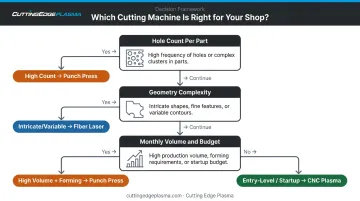
Those parts, not a machine's theoretical capability, determine which technology delivers ROI.
For shops at the start of their CNC cutting journey — whether fabricating custom automotive parts, signage, or architectural metalwork — Cutting Edge Plasma's plasma table lineup offers a practical entry point. From there, the same supplier carries fiber laser systems for shops ready to scale into higher-precision, higher-volume sheet metal cutting.
Conclusion
Fiber lasers offer unmatched flexibility for diverse, complex, precision-critical work. CNC punch presses remain the throughput leader for hole-intensive, high-volume production with forming requirements. The right choice depends on your actual production mix — not a theoretical capability ranking where one technology wins on paper.
Both technologies demand meaningful capital investment and ongoing operational costs. Before committing, run the numbers on your specific part families, factor in secondary operations and tooling overhead, and account for where your production volume is headed over the next two to three years.
If the capital requirements for either machine put them out of reach right now, CNC plasma cutting is worth a serious look. Plasma tables start well under $30,000 — compared to $54,000+ for entry-level fiber laser systems — and handle structural steel, plate work, and profile cutting across a wide range of fabrication jobs. It's a practical starting point for shops that need real production capability before scaling into laser or punch press investment.
Frequently Asked Questions
Frequently Asked Questions
What is better, CNC or laser?
The question conflates two different things: CNC is the control system, not the cutting method. The real choice is between technologies — punch press, fiber laser, or plasma. Fiber lasers win on complex geometry and thin-to-mid-gauge speed; punch presses win on repetitive forming operations at high volume; plasma offers the most accessible entry point for thicker structural cuts.
What is the best type of laser for cutting metal?
Fiber lasers are the strongest option for metal cutting today. Bystronic reports that fiber lasers can be up to 5x more electrically efficient than CO2 systems, with superior speed and lower maintenance requirements across most metal cutting applications.
Can a CNC punch press cut complex shapes?
Intricate profiles and irregular geometries expose the punch press's core limitation: every unique shape requires a dedicated tool. For standardized features and high-volume repetitive punching, they perform well. Contour cutting without heavy tooling investment is where fiber lasers have a clear advantage.
What is the maximum material thickness a CNC punch press can handle?
Most CNC punch presses max out at approximately ¼" (6mm). Fiber lasers, by contrast, can process significantly thicker materials depending on power. TRUMPF's published specs, for example, show high-power systems reaching 60mm at 24kW.
Is a fiber laser worth the investment for a small fabrication shop?
It depends on order mix. Small shops running diverse, complex parts can see strong ROI, with entry-level 3kW systems starting around $54,000. Shops not yet at that volume often start with a CNC plasma table — a significantly lower entry cost — then scale into laser as production demands grow.
What are the main ongoing operating costs of a fiber laser?
Primary cost drivers include assist gases (nitrogen and oxygen), optics and lens maintenance, chiller system operation, and periodic laser source servicing. These costs are generally lower than CO2 laser systems but should be factored carefully into total ownership cost calculations.