This guide breaks down how each technology works, where each one wins, and how to decide which fits your actual material mix and production goals — including when neither laser might be the right call at all.
Key Takeaways
- Fiber lasers operate at ~1.064 µm and cut metals up to 5x faster than CO2 lasers on comparable setups
- CO2 lasers operate at ~10.6 µm and remain the preferred choice for wood, acrylic, plastics, and other non-metallic materials
- Fiber lasers carry higher upfront costs; CO2 lasers cost less to buy but more to run over time
- The right choice depends on material type, thickness range, throughput needs, and total budget
Fiber vs CO2 Laser Cutting: Quick Comparison
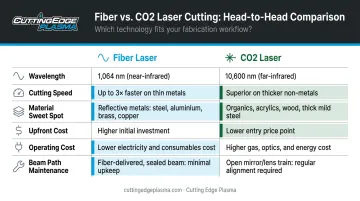
The table below covers the six factors that most directly affect which technology fits your shop — speed, materials, cost, and maintenance.
| Factor | Fiber Laser | CO2 Laser |
|---|---|---|
| Wavelength | ~1.064 µm | ~10.6 µm |
| Cutting Speed (Metals) | Up to 5x faster | Slower, but effective on thick mild steel |
| Material Sweet Spot | Metals, including reflective types | Non-metals; thick mild steel with oxygen assist |
| Upfront Cost | Higher | Lower |
| Operating Cost | Much lower | Higher (energy, gas, mirrors) |
| Beam Path Maintenance | None — fully sealed, no mirrors | Regular mirror alignment and cleaning required |
Real-world performance depends on machine power (kW), material thickness, assist gas selection, and configuration — so treat these comparisons as directional, not absolute. The sections below break down where each technology earns its place.
What Is Fiber Laser Cutting?
Fiber lasers generate a beam by passing light through rare-earth-doped optical fibers (typically ytterbium) which amplify the beam and deliver it to the cutting head through a fiber optic cable. This solid-state design produces a shorter wavelength (~1.064 µm), higher power density at the focal point, and a fully sealed beam path with no mirrors to align or clean.
Operational Advantages
The practical benefits for fabricators are significant:
- Energy efficiency — Fiber lasers typically achieve around 30% wall-plug efficiency, compared to roughly 10% for CO2 systems. Bystronic reports that a 10 kW fiber laser consumes approximately one-fifth the power of two equivalent CO2 machines
- No beam path maintenance — No mirror cleaning, no bellows checks, no beam alignment procedures
- Minimal warm-up time — Fiber lasers reach operating condition almost immediately, reducing idle labor cost
- Speed on metals — Bystronic benchmarks show fiber lasers can achieve three to five times greater throughput than conventional CO2 lasers on sheet metal
Reflective Metals: Where Fiber Has a Clear Edge
CO2 lasers have historically struggled with aluminum, copper, and brass. The longer 10.6 µm wavelength tends to reflect off polished metal surfaces rather than absorb into them. Fiber's shorter wavelength absorbs far more efficiently into these materials. That makes copper and brass practical at production speeds where CO2 simply cannot operate safely or reliably.
Honest Limitations
Fiber lasers aren't the answer to everything:
- Poor performance on non-metallic materials (wood, acrylic, textiles, leather)
- Can produce rougher edges on very thick steel compared to CO2 with oxygen assist
- Higher upfront purchase price — a real barrier for hobbyists and smaller shops
Where Fiber Lasers Fit Best
- High-volume sheet metal cutting of stainless steel, mild steel, aluminum, copper, and brass
- Precision parts for automotive, aerospace, electronics, and medical device manufacturing
- Intricate cuts on thin-gauge metals where speed and edge quality both matter
Grand View Research reports that the solid-state laser cutting machine segment held 43.3% of the laser cutting market in 2023, driven largely by sheet metal fabrication demand shifting toward fiber technology.
What Is CO2 Laser Cutting?
CO2 lasers work by electrically stimulating a gas-filled tube containing carbon dioxide, nitrogen, and helium, producing a beam at ~10.6 µm wavelength. That longer wavelength is highly absorbed by organic and non-metallic materials, which is precisely where CO2 excels.
Operational Characteristics
CO2 systems come with a different set of trade-offs compared to fiber:
- Higher energy draw per cut — roughly 10% wall-plug efficiency vs. fiber's ~30%
- Optical mirrors and beam path components require regular cleaning and alignment
- Despite these costs, CO2 delivers superior edge quality and smooth finishes on wood, acrylic, MDF, rubber, and plastics — surfaces that fiber lasers simply cannot match
Thick Plate Steel: CO2's Metal Niche
With oxygen as an assist gas, CO2 lasers cut thick mild steel effectively. TRUMPF's 2D laser cutting brochure documents capability up to 25 mm mild steel and 15 mm stainless steel at 12 kW. Bystronic lists selected models handling material thicknesses up to 50 mm.
Fiber lasers have narrowed this gap through beam shaping technology — adjustable-mode-beam designs now offer improved edge quality on thicker plate. For heavy-plate structural applications, CO2 with oxygen assist remains the more proven choice.
Honest Limitations
CO2 does have real drawbacks worth weighing before you commit:
- Struggles with reflective metals (aluminum, copper, brass) due to back-reflection risk
- Slower on thin sheet metal compared to fiber
- Higher long-term operating costs from energy consumption, consumable gas, mirror replacement, and vacuum pump maintenance
Where CO2 Lasers Fit Best
- Non-metallic materials: wood, acrylic, MDF, rubber, leather, textiles, plastics
- Industries including signage, woodworking, furniture, and custom fabrication
- Heavy plate mild steel cutting in structural and industrial manufacturing
- Applications where smooth engraved or cut edge finish on organic materials is the priority
Trotec's customer base illustrates this well. Sign shops and design studios rely heavily on CO2 for displays, architectural models, prototypes, and custom artwork — work where fiber lasers simply don't compete on finish quality.
Fiber vs CO2 Laser: Which Is Right for You?
The Decision Factors
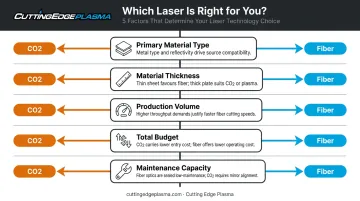
Five variables drive this choice more than any other:
- Primary material type — Metal vs. non-metal determines roughly 80% of this decision
- Typical material thickness — Thin-to-medium metals favor fiber; very thick mild steel and non-metals favor CO2
- Production volume — Higher throughput requirements push toward fiber's speed advantage
- Total budget — Upfront cost vs. 3–5 year operating cost look very different between the two technologies
- Maintenance capacity — CO2 requires more ongoing attention; fiber is lower maintenance by design
Clear-Cut Guidance
Choose fiber if you:
- Primarily cut metals, especially stainless steel, aluminum, copper, or brass
- Need high throughput and want to minimize long-term operating costs
- Cut thin-to-medium gauge sheet metal regularly
Choose CO2 if you:
- Work primarily with non-metallic materials (wood, acrylic, MDF, plastics)
- Need to cut very thick mild steel plate with oxygen assist
- Have limited upfront capital and non-metal cutting is your core work
The 5–20 mm Metal Zone
This thickness range is where both technologies genuinely compete. Fiber lasers generally maintain a speed advantage across most metals in this range. However, CO2 with oxygen assist can deliver better edge quality on thicker mild steel. If your primary work sits in this zone, request test cuts on your actual material before committing to either system.
The Mixed-Shop Scenario
Consider a small fabrication shop cutting thin stainless brackets, occasional acrylic signage, and thicker structural mild steel. No single laser type covers all three jobs equally well. A fiber laser handles the stainless and the thicker steel but leaves the acrylic work underserved. A CO2 system covers the acrylic and thick plate but loses badly on thin metal throughput.
The practical question for most shops is simpler than it seems: what does 80% or more of your work actually look like? For shops dominated by structural steel cutting in thicker gauges — not precision thin sheet work — a CNC plasma cutting table often makes far more economic sense than either laser type. Cutting Edge Plasma's iPlasma XTREME series, starting at $17,495, is built for exactly this kind of shop: fabricators who need reliable metal cutting on steel without the capital commitment of a laser system.
Cost of Ownership Reality Check
Sticker price comparisons between fiber and CO2 are misleading without factoring in operating costs. The verifiable cost drivers from manufacturer data:
- Fiber uses up to 5x less electricity per equivalent power output than CO2
- Fiber eliminates beam path maintenance costs entirely (no mirrors, no alignment)
- CO2 carries ongoing costs from consumable gas, mirror replacement, and vacuum pump servicing
- Fiber's speed advantage means more parts per shift — directly reducing per-part cost at volume
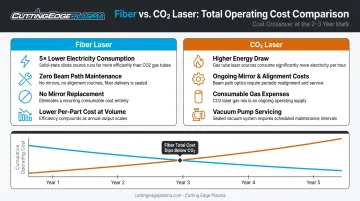
For shops running consistent metal cutting volume, fiber's total cost of ownership typically crosses below CO2's within 2–3 years — making the upfront price gap far less significant than it first appears.
Conclusion
Neither fiber nor CO2 is the universal answer — the right machine is the one that matches your actual material mix, not your aspirational one.
Fiber lasers lead on metal cutting speed, energy efficiency, and long-term operating economics. CO2 lasers remain the practical choice for non-metallic materials, creative applications, and certain thick-plate metal work where proven edge quality matters more than throughput.
For fabricators focused on structural steel and thicker metals at a more accessible price point, CNC plasma cutting — like the iPlasma XTREME tables from Cutting Edge Plasma — belongs in the conversation. Plasma delivers comparable cut quality on mid-range plate thicknesses at a fraction of the capital cost, which often makes it the faster path to profitability for small and mid-size shops. If you're weighing options, Cutting Edge Plasma's team can walk you through which technology fits your actual production requirements.
Frequently Asked Questions
Which is better for cutting metal sheets: fiber or CO2 lasers?
Fiber lasers are the better choice for most metal sheet cutting — they deliver higher power density, faster speeds, and better absorption across stainless steel, aluminum, and reflective metals. CO2 can cut thicker mild steel with oxygen assist but is less efficient on metals overall.
Can both fiber and CO2 lasers cut metal sheets?
Yes, both technologies cut metal, but with different strengths. Fiber excels at most metals and handles reflective types like copper and brass well. CO2 is more limited with reflective metals and performs best on thicker mild steel using oxygen assist gas.
What is the lifespan difference between fiber and CO2 lasers?
Fiber lasers outlast CO2 systems by a wide margin — their sealed, solid-state construction has no mirrors or gas tubes to degrade. CO2 sources typically reach around 10,000 run-hours under standard use, with some exceeding 20,000 hours under controlled conditions, per Kern Laser Systems.
Is a fiber laser worth the higher upfront cost?
For shops doing regular metal cutting, yes. Lower electricity costs, minimal maintenance, no warm-up downtime, and faster throughput typically justify the initial investment within a few years — making total cost of ownership favorable compared to CO2.
What materials can CO2 lasers cut that fiber lasers cannot handle as well?
CO2 lasers excel on wood, acrylic, MDF, rubber, leather, textiles, and many plastics — materials that absorb CO2's wavelength efficiently and produce clean edges. Fiber lasers typically cannot replicate those results on non-metallic substrates.
Why does the wavelength difference between fiber and CO2 matter so much?
Fiber lasers emit at ~1.064 µm — roughly ten times shorter than CO2's ~10.6 µm. That shorter wavelength gives fiber higher power density and better absorption into metals, while CO2's longer wavelength is better absorbed by organic and non-metallic materials. In practice, wavelength is the primary factor determining which laser belongs in your shop.