Laser welding addresses this directly. Its focused beam delivers concentrated energy with far lower overall heat input than TIG or MIG, which is why fabricators working on food-grade equipment, pharmaceutical tubing, and marine hardware have been shifting toward it.
This guide covers everything you need to weld stainless steel with a laser: why it outperforms arc processes, how different grades behave, how to prep your material correctly, which parameters matter most, shielding gas selection, and how to solve the defects that show up most often. It's written for fabricators, small shop owners, and hands-on builders who want clean, distortion-free results with less rework.
Key Takeaways
- Laser welding produces a significantly narrower heat-affected zone than TIG or MIG, preserving stainless steel's corrosion resistance
- Austenitic grades (304, 316L) are the most weld-friendly; martensitic grades require careful handling due to cracking risk
- Dedicated stainless-only tools are non-negotiable—carbon steel contamination causes rust at the weld zone
- Argon is the safest all-around shielding gas; nitrogen suits austenitic and duplex grades but carries specific restrictions
- Power, travel speed, focal position, and pulse frequency are interdependent, so dial them in together on scrap before committing to production runs
Why Laser Welding Is Ideal for Stainless Steel
The core problem with TIG and MIG on stainless isn't heat itself—it's where that heat goes. Because stainless has such low thermal conductivity, the arc's energy lingers near the joint rather than spreading through the part. IMOA notes that this concentrates shrinkage stress and distortion in austenitic stainless far more severely than in carbon steel.
The consequence that fabricators dread most is sensitization. According to SSINA, chromium carbides precipitate at grain boundaries when austenitic stainless is held in the 950–1450°F range. Once that happens, the chromium that gives stainless its corrosion resistance is effectively consumed at the grain boundary—leaving the surrounding metal vulnerable to intergranular corrosion.
Laser welding's fast, focused pass spends far less time in that danger zone.
Laser Welding vs. TIG vs. MIG: A Practical Comparison
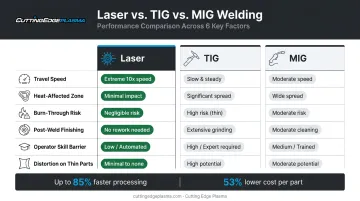
| Factor | Laser | TIG | MIG |
|---|---|---|---|
| Travel speed | Very fast (e.g., 8–13 m/min at 1.5 mm) | Slow (manual pace) | Moderate |
| Heat-affected zone | Narrow | Wide | Moderate |
| Burn-through risk (thin sheet) | Low with pulsed mode | Higher | Higher |
| Post-weld finishing | Often none required | Typically required | Typically required |
| Operator skill barrier | Lower | High | Moderate |
| Distortion on thin parts | Minimal | Significant | Moderate |
TRUMPF reports that automated laser joining can reduce processing time by up to 85% and cost per part by 53%. In one documented example, a complex housing that previously took 2 hours was laser-welded in 5 minutes. That speed advantage isn't just about productivity. Less time on the joint means less accumulated heat, which reduces distortion on thin-wall stainless tubing and precision sheet metal.
Speed also compounds with another real-world advantage: operator accessibility. TIG welding stainless to a high standard takes years to master. Laser welding requires less manual arc control, which means fewer burn-throughs and more consistent beads for operators who aren't seasoned TIG welders — a meaningful edge for shops dealing with welder shortages.
Types of Stainless Steel and Their Weldability
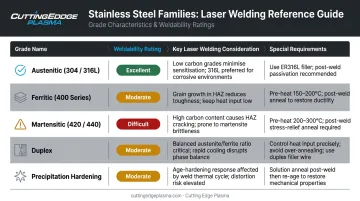
Stainless steel isn't one material. There are five microstructural families, and they behave very differently under a laser beam.
Austenitic (304, 316L) — Most Weld-Friendly
These are the grades most fabricators encounter. Their nickel content stabilizes the austenite structure, making them well-suited to laser welding. Coherent identifies 304/304L as the best stainless to weld, and 316L's low carbon content reduces sensitization risk even further—an important consideration for food-grade and marine applications.
Ferritic (400 Series)
Good corrosion resistance at lower cost, but the HAZ can experience grain coarsening. Euro Inox documents a laser example: approximately 6 kW welding 2 mm stabilized 17% Cr ferritic strip at 7 m/min, with extremely limited HAZ grain coarsening because the thermal cycle is so brief. That brief cycle is where laser welding earns its keep on ferritic grades.
Martensitic (420, 440)
These are the difficult grades. High carbon content creates a real cold cracking risk—Euro Inox notes sensitivity below approximately 400°C depending on carbon content, hydrogen, and residual stress. Preheating and post-weld heat treatment are typically recommended. For thicker martensitic sections, TIG welding with controlled preheat is often a more practical alternative.
Duplex Stainless
Duplex grades are high-strength alloys used in offshore, chemical processing, and pressure vessel applications—but they require careful shielding gas management. The weld metal must maintain the right austenite-to-ferrite balance. Without nitrogen-bearing shielding gas, mechanical and corrosion properties in the weld zone suffer. Get the shielding gas wrong and you'll lose the corrosion resistance you paid a premium for.
How to Prepare Stainless Steel Before Laser Welding
Surface preparation on stainless steel isn't just a quality step—it's a contamination control problem.
Eliminate Carbon Steel Contamination
Any carbon steel particle that embeds in stainless steel will rust. According to ASSDA, that rust forms iron oxide and eventually ferric chloride, undermining the entire reason you chose stainless.
BSSA confirms that every tool touching stainless must be dedicated exclusively to stainless. That means:
- No steel wool — prohibited outright
- No shared grinders or wire brushes from carbon steel work
- Dedicated clamps and backing bars for stainless only
- A clean work surface free of carbon steel debris
Clean the Joint Area
Wipe the weld zone with a clean, lint-free cloth and an appropriate solvent to remove oils, cutting fluids, and shop grime before welding. Laser welding's tight focal point amplifies surface contamination directly into weld defects—porosity and discoloration both trace back to inadequate cleaning more often than parameter errors.
Get Your Fit-Up Right
Laser welding has a tighter tolerance for gap size than TIG or MIG. Poor joint fit-up leads directly to incomplete fusion or porosity. Starting with accurately cut blanks makes this easier to control. Fabricators using a CNC plasma table — like the iPlasma XTREME series — get consistently dimensioned stainless blanks that give laser welding the tight fit-up it needs from the start.
Key Parameters to Optimize When Laser Welding Stainless Steel
No single parameter controls weld quality. Power, travel speed, focal position, and pulse settings work together, and adjusting one means reconsidering the others.
Laser Power
Power determines how much energy reaches the material. Higher power enables deeper penetration for thicker stainless sections; too much on thin material causes burn-through. TRUMPF documents stainless steel welded at 8–13 m/min at 1.5 mm and 18 m/min at 1 mm as practical reference points—showing how material thickness directly shapes the power and speed combination you'll need.
Travel Speed
Faster travel means less heat input and less distortion, but too fast produces incomplete fusion. For thin stainless under 1.5 mm, faster speeds are typically preferred to keep the HAZ as narrow as possible. Thicker material benefits from slower travel for better control and penetration.
Focal Position
Positioning the focal point at or just below the surface maximizes energy coupling into the stainless. A slightly defocused beam widens the weld pool, which can help bridge small gaps—useful when fit-up isn't perfect.
Pulse Frequency and Duty Cycle
For thin stainless under 1.5 mm, pulsed laser mode is the preferred approach. Euro Inox recommends matching laser type to thickness:
- Pulsed YAG lasers: best for stainless sheet thinner than 1.5 mm
- CO₂ lasers: suited to the 1.5–6.0 mm range
Short, controlled energy bursts prevent heat from accumulating and keep the HAZ tight—critical on thin stainless where thermal buildup causes warping or discoloration.
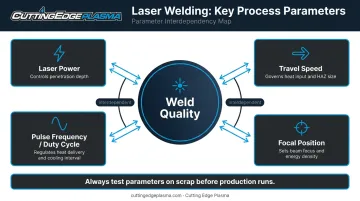
Before committing to production settings: run test welds on scrap of the same grade and thickness. Parameters that work on 304 sheet don't automatically apply to 316L tubing of a different wall thickness.
Choosing the Right Shielding Gas for Laser Welding Stainless Steel
Without shielding gas, the hot weld pool oxidizes immediately, causing discoloration, porosity, and reduced corrosion resistance. The gas must protect both the top bead and, for full-penetration welds, the root side.
Main Gas Options
- Helium — Euro Inox identifies helium as the shielding gas for laser beam welding specifically, with argon used as the plasma gas in the process
- Argon/Helium mixtures — used at higher laser power levels to manage plasma formation
- Nitrogen — suitable for austenitic and duplex grades; helps maintain nitrogen content in the weld metal and is more cost-effective than argon (it can also be generated on-site)
Nitrogen restriction — stabilized grades only: Do not use nitrogen with titanium- or niobium-stabilized austenitic grades (such as 321 or 347) due to nitride formation risk. Always verify your grade before selecting nitrogen.
Hydrogen — ferritic, martensitic, and duplex grades: Hydrogen-containing mixtures must not be used with these grades. Hydrogen embrittlement risk makes these combinations dangerous for structural integrity.
Backing Gas for Full-Penetration Welds
When welding pipe or tube with full penetration, the root side needs protection too. IMOA recommends three backing gas options for austenitic stainless fabrication:
- Argon — reliable, broadly compatible across stainless grades
- Nitrogen — cost-effective for austenitic and duplex grades (apply hydrogen caution above to ferritic, martensitic, and duplex)
- 90% N₂/10% H₂ (Formier gas) — effective for austenitic grades; strictly prohibited with ferritic, martensitic, and duplex steels
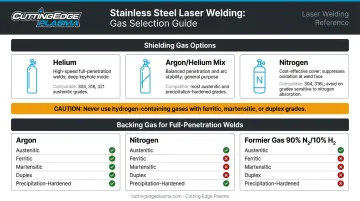
Inadequate root-side protection causes oxidation that compromises corrosion resistance even when the top bead looks perfect.
Common Laser Welding Problems on Stainless Steel and How to Solve Them
Porosity and Gas Inclusions
Porosity in stainless laser welds typically traces to one of three sources: surface contamination (oils or oxides), trapped shielding gas, or parameters that cause rapid solidification before gas can escape the melt pool. Research from OSTI/LLNL found near-complete elimination of porosity in 304L stainless keyhole laser welds when switching from argon to nitrogen shielding—demonstrating how strongly gas selection influences this defect.
Solutions:
- Thorough solvent cleaning before welding
- Verify shielding gas flow rate and nozzle coverage
- Adjust power and speed to allow proper outgassing from the melt pool
Discoloration and Root-Side Oxidation
Heat tint is a direct indicator of oxidation. BSSA documents the color progression: pale yellow at 290°C, straw yellow at 340°C, dark yellow at 370°C, brown at 390°C. IMOA confirms that heat tint substantially reduces pitting and crevice corrosion resistance in standard austenitic stainless steels—so this isn't just a cosmetic issue.
Root-side oxidation (the granular, rough texture sometimes called "sugaring") indicates the weld root was completely unprotected during welding.
Solutions:
- Improve shielding gas coverage on the top bead
- Add backing gas for any full-penetration weld
- Increase travel speed to reduce dwell time at high temperature
Distortion and Warping
Stainless steel's high coefficient of thermal expansion and low thermal conductivity make it more warp-prone than carbon steel when heat builds unevenly. That combination punishes sloppy sequencing fast.
Solutions:
- Use intermittent (stitch) welding rather than continuous passes on long seams
- Weld in balanced sequences to distribute heat evenly across the part
- Use fixturing and clamps to hold parts during the weld cycle
- Follow IMOA's guidance: tighter tack spacing than carbon steel, and copper backing bars to cool sheet welds while containing shielding gas
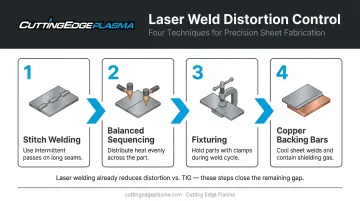
Laser welding already cuts distortion significantly compared to TIG — tighter heat input, smaller HAZ, less cumulative warping. These sequencing techniques close the remaining gap.
Frequently Asked Questions
Can laser welders weld stainless steel?
Yes—laser welding is one of the most effective methods for stainless steel. The focused beam minimizes the heat-affected zone and preserves corrosion resistance better than TIG or MIG, making it particularly well-suited to food-grade, pharmaceutical, and marine applications.
What is the thickest stainless steel a laser welder can weld?
Laser power determines the limit. Entry-level 1 kW handheld systems typically handle up to 1/8 in. (3 mm) in a single pass, while 1.5–3 kW systems can reach 6–10 mm or more using multi-pass techniques.
What gas do you use for laser welding stainless steel?
Argon is the most common shielding gas for laser welding stainless steel, with helium added at higher power levels to manage plasma formation. Nitrogen is a cost-effective alternative for austenitic and duplex grades, though argon/helium blends offer better control in demanding applications.
Is laser welding stainless steel stronger than TIG welding?
A peer-reviewed study on 3 mm 304 stainless found that the laser-welded joint produced the highest tensile strength and smallest dendrite size compared to TIG and hybrid laser-TIG welds. The narrow HAZ causes fewer metallurgical changes in surrounding material, reducing intergranular corrosion risk.
Do you need filler wire for laser welding stainless steel?
Not always. Laser welding can be done autogenously (without filler) on tight-fit joints. Filler wire is recommended when bridging gaps, adding material to the joint, or welding dissimilar metals. When used, the filler grade should match or slightly exceed the alloy content of the base material.
What causes discoloration when laser welding stainless steel?
Discoloration is caused by oxidation of the hot weld metal—typically from inadequate shielding gas coverage, excessive heat input from slow travel speed, or insufficient backing gas on the root side. Improving gas coverage and increasing travel speed usually resolves it.