The core difficulty isn't equipment. It's physics. Aluminum melts at 657°C while AISI 304 stainless steel melts between 1,400–1,455°C — a gap of roughly 743–798°C. That gap, combined with brittle intermetallic compound formation and aluminum's oxide layer problem, makes this one of the most punishing material combinations in the shop.
This guide covers why the joint is hard, what equipment and materials you need, the step-by-step process, the critical variables that determine success or failure, and what to do when results go wrong.
Key Takeaways
- The 743–798°C melting point gap between aluminum and stainless steel is the root cause of most weld failures
- Beam offset toward the stainless steel side is the single most impactful technique variable
- Zero-gap fit-up is not optional — any gap accelerates intermetallic formation and melt pool instability
- Oxide removal must happen right before welding — aluminum oxide re-forms within minutes of cleaning
- Beam oscillation with tuned frequency and amplitude directly reduces intermetallic compound thickness
Why Laser Welding Aluminum to Stainless Steel Is So Challenging
The Melting Point Gap Problem
According to ASM International's aluminum data and MatWeb's AISI 304 specifications, pure aluminum melts at 657°C while AISI 304 stainless steel melts at 1,400–1,455°C. That's a difference of 743–798°C.
In practice, this means aluminum is fully liquid — and flowing — before the stainless steel side has begun to soften. Controlling what happens to that molten aluminum before sufficient fusion occurs at the steel interface is the central challenge of this weld.
Fe-Al Intermetallic Compound Formation
When aluminum and iron mix in the molten state, they form brittle intermetallic phases. A 2015 Materials & Design study on fiber laser welding of SS304L to AA5083 identified five distinct intermetallic phases in the joint: FeAl₂, Fe₂Al₅, FeAl₃, Fe₃Al, and FeAl. Typical joints failed at the steel-weld interface through brittle fracture, averaging 2.812 kN shear strength. With flux assistance (CaF₂), strength reached 5.656 kN — roughly double.
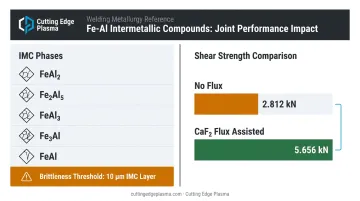
The critical threshold appears to be an intermetallic compound (IMC) layer thickness of 10 µm. Above that, brittleness dominates joint behavior.
Aluminum's Oxide Layer
Aluminum is always covered by a natural aluminum oxide (Al₂O₃) film. That film melts at 2,072°C — far above aluminum's 657°C melting point. When present during welding, it resists fusion, breaks up unevenly in the melt pool, and creates inclusion defects that weaken an already metallurgically stressed joint.
This oxide problem compounds the IMC challenge: even if you manage heat input carefully, oxide inclusions in the melt pool introduce additional failure points. That's why process control — specifically the choice of welding technology — matters so much for this dissimilar-metal combination.
Why Fiber Laser Handles This Better Than Arc Processes
TIG and MIG welding introduce significantly more heat over a larger area and longer time period than laser welding. That extended heat exposure drives more aluminum into the melt pool, thickens the IMC layer, and gives intermetallics more time to grow.
Fiber laser welding's concentrated heat input keeps the molten zone small and the weld duration short, both of which directly limit IMC formation. Automotive manufacturers adopted laser welding for aluminum-to-steel joints precisely because shorter exposure times produce thinner, more controlled intermetallic layers — and thinner IMC layers mean joints that actually hold.
What You Need Before Laser Welding Aluminum to Stainless Steel
Equipment and System Requirements
Research-verified direct data for aluminum-to-stainless fiber laser welding shows two distinct power regimes:
| Study | Materials | Laser Power | Speed |
|---|---|---|---|
| Ezazi et al., 2015 | 1 mm SS304L over 3 mm AA5083 | 300 W, 1070 nm | 4–10 mm/s |
| Li/Chen/Kang, 2026 | 1 mm 304 SS over 1 mm 6061 Al | 800 W, oscillating | 30 mm/s |
These are starting-point parameters from peer-reviewed sources. Higher-wattage machines (1.5–3 kW, such as the QLTEK Water-Cooled Laser Welding Machine) offer more flexibility for thicker material combinations and faster travel speeds, but parameters must be developed empirically for each material thickness.
Strongly recommended capabilities for this combination:
- Beam oscillation/wobble-head: A 2026 IPG study found 1 mm amplitude at 60 Hz cut IMC thickness from 16.2 µm to 6.1 µm (a 62% reduction)
- Adjustable focus position — critical for offsetting toward the stainless side
- Consistent travel speed control — programmed passes outperform hand-controlled ones for repeatability
Fit-up matters as much as machine settings. The 2015 study clamped workpieces to full contact with zero gap — gaps cause keyhole fluctuation, melt-pool instability, and notch effects at the joint. Parts need to be precision-cut before surface prep begins. CNC plasma-cut edges (such as those from the iPlasma XTREME) provide the dimensional consistency needed to minimize fit-up variation.
Materials, Consumables, and Safety
Filler wire: Silicon-bearing aluminum fillers such as ER4043 (5% Si) and ER4047 (12% Si) are commonly used, with ER4047 offering a narrower melting range and better crack resistance. Verify filler selection against current metallurgical guidance for your specific alloy grades — direct peer-reviewed confirmation for aluminum-to-stainless laser welding is limited.
Shielding gas: Peer-reviewed data confirmed argon at 20 L/min as the baseline for this combination.
PPE and safety requirements per OSHA:
- Laser-rated eye protection at the correct optical density for your laser wavelength (~1070 nm for fiber lasers; OD 7+ recommended)
- Flame-retardant clothing and gloves
- Fume extraction — dissimilar metal welds produce more complex fume compositions than single-material welds
- Comply with ANSI Z136.1 laser safety standards
How to Laser Weld Aluminum to Stainless Steel: Step-by-Step
Step 1: Surface Preparation and Oxide Removal
This step determines whether your weld has a chance. There's no recovering from skipped prep.
For aluminum:
- Remove oils and grease first using acetone (Lincoln Electric confirms acetone as the appropriate solvent)
- Remove the oxide layer using a stainless steel wire brush — dedicated to aluminum only, never shared with ferrous materials
- Weld immediately after prep — oxide re-forms within minutes on exposed aluminum
For stainless steel:
- Wipe with acetone to remove oils, mill scale, and surface contamination
- Any residue on either surface accelerates porosity and intermetallic formation
Step 2: Joint Design, Fit-Up, and Fixturing
- Lap joints and butt joints with zero gap are most commonly used and studied for this combination
- Joint geometry affects how much aluminum mixes with steel in the melt pool — simpler geometries with minimal weld pool volume are preferable
- Clamp both pieces firmly; thermal movement during welding can shift the laser beam off its offset position by fractions of a millimeter, which worsens IMC formation significantly
Step 3: Laser Parameter Setup and Beam Offset Strategy
Beam offset toward the stainless steel side is the most important technical variable in this process. By focusing the laser on the stainless steel surface—not the aluminum—you can precisely control the Al-Fe mixing ratio.
This technique reduces direct aluminum melting and limits the volume of molten aluminum entering the pool, a strategy validated in a 2015 fiber laser study.
Configure your starting parameters based on your material thickness and verify against verified research data:
- Power: Develop empirically for your section thickness; the verified range spans 300–800 W for 1 mm material
- Speed: 6 mm/s showed best results for typical (no flux) joints in the 2015 study; 30 mm/s at 800 W in a 2021 oscillating study
- Oscillation (if equipped): 1 mm amplitude at 60 Hz — the verified optimal condition from the 2026 study
- Focus position: On or offset toward the stainless steel surface, not into the aluminum
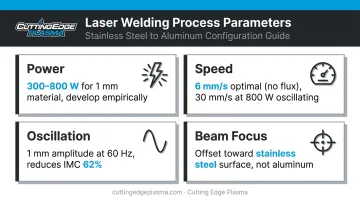
These settings are adjustable on modern handheld laser welders, such as the QLTEK systems, allowing for fine-tuning based on your specific application.
Step 4: Welding Execution and Post-Weld Inspection
- Run a programmed, consistent travel speed pass — pausing or slowing mid-pass concentrates heat and amplifies intermetallic growth
- Hand-controlled passes introduce speed variation; automated or mechanized motion is preferable for repeatability
Post-weld inspection checklist:
- Visual check for porosity, surface cracking, or irregular bead profile
- Check for discoloration indicating oxidation (inadequate shielding)
- Light mechanical cleaning if needed
- Note: avoid post-weld heat treatment unless confirmed appropriate for your specific alloy combination — heat treatment can accelerate intermetallic growth in Al-Fe joints
Key Parameters That Affect Results
Getting these variables right is what separates a sound joint from a brittle one. Each parameter below has a narrow working range — and they interact with each other, so adjusting one often requires revisiting the others.
Laser Power and Energy Density
Power determines whether you achieve fusion on both sides without flooding the melt pool with excess aluminum. Below 300 W, a 2015 study found the laser "could hardly penetrate the aluminum bulk even at speeds below 5 mm/s." Too much power overmelts the aluminum side, flooding the pool with liquid Al and significantly increasing IMC volume. The target is the minimum power that achieves fusion on both sides — nothing more.
Welding Speed
Speed directly controls IMC layer thickness, which in turn controls joint brittleness. Slower speeds give the intermetallic compounds more time to grow; faster speeds can cause cracking and material loss.
From the 2015 study:
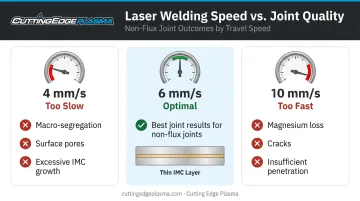
- 4 mm/s: Macro-segregation, surface pores, excessive brittle IMC formation
- 6 mm/s: Best results for typical (non-flux-aided) joints
- 10 mm/s: Severe magnesium loss, cracks, insufficient aluminum penetration
Beam Offset and Focus Position
Offsetting the beam toward the stainless steel side reduces aluminum liquefaction and keeps the IMC layer thinner. Focusing into the aluminum instead causes excessive plasma formation, porosity, and spatter. The 2026 oscillating beam study used 0 mm defocus with steel positioned on top and the beam incident on the steel surface — a configuration worth replicating as a baseline.
Shielding Gas Flow and Coverage
- Verified data: 20 L/min argon for the 2026 IPG fiber laser lap-weld study
- Inadequate coverage allows aluminum oxidation, creating oxide inclusions that further weaken the joint
- Ensure nozzle positioning covers both the weld zone and the heat-affected area on the aluminum side
Common Mistakes When Laser Welding Aluminum to Stainless Steel
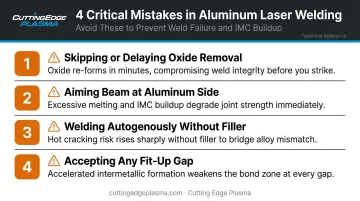
Even experienced welders run into trouble with this material combination. These four errors account for the majority of failed or cracked joints:
- Skipping oxide removal or delaying too long after prep: aluminum oxide re-forms rapidly — surface prep done an hour before welding may already be ineffective by the time the arc starts
- Aiming the beam at the aluminum side: the single most common setup error, producing excessive aluminum melting, plasma formation, and IMC buildup at the interface
- Welding autogenously when filler is needed: going without filler wire when a gap exists — or when working with crack-sensitive alloy grades — sharply increases hot cracking risk
- Accepting any fit-up gap: even small gaps that are acceptable in same-material welds become disqualifying here, accelerating intermetallic compound formation at the joint interface
Troubleshooting and Alternatives
Problem 1 — Porosity in the Weld Bead
Likely causes: Residual oxide on aluminum, insufficient shielding gas coverage, or moisture in filler wire or base material.
What to check: Confirm surface prep happened in the same session as welding. Verify shielding gas flow rate and nozzle position. Check filler wire storage — wire left exposed to humidity absorbs moisture.
Problem 2 — Brittle Joint That Cracks Under Stress
Likely causes: IMC layer too thick, caused by too-low speed, too-high power, or beam positioned into the aluminum rather than offset toward stainless.
What to check: Increase welding speed. Reduce power. Re-evaluate beam offset. Consider whether joint design can reduce overall weld pool volume.
Problem 3 — Burn-Through or Excessive Aluminum Melting
Likely causes: Power too high for aluminum section thickness, or speed too slow. Aluminum is always the more vulnerable material.
What to check: Reduce power, increase speed. Evaluate whether fixturing can act as a heat sink on the aluminum side.
Alternative: Friction Stir Welding (FSW)
FSW is a solid-state process that generates far less heat than fusion welding. Despite common claims to the contrary, FSW does not eliminate intermetallic compounds in aluminum-to-stainless joints. A 2023 FSW study on 7075 aluminum/AISI 304 found FeAl₃, Fe₃Si, FeAl, Fe₄Al₁₃, and Fe₃Al₂Si₄ in the weld zone.
A comparable 6061/304 FSW study recorded an IMC layer thickness of 1.47 µm at optimal traverse speed — thinner than fusion welding, but still present.
FSW works best for flat, accessible joints in production environments and requires specialized tooling. It's not suitable for complex 3D shapes or field repairs.
Alternative: Adhesive Bonding or Mechanical Fastening
For applications where load can be distributed across a larger surface area, structural adhesives or mechanical fasteners offer reliable dissimilar metal joining. Key trade-off: galvanic corrosion. ASSDA notes that when stainless steel carries a larger wetted area than aluminum, the aluminum corrodes rapidly at contact points. Aluminum fasteners in stainless steel require isolation or coating — direct contact accelerates galvanic attack.
Frequently Asked Questions
How do you join aluminum to stainless steel?
The most effective methods are fiber laser welding with beam offset toward the stainless side and appropriate filler, friction stir welding for flat production joints, or mechanical fastening with galvanic isolation. Direct fusion welding is achievable but demands precise parameter control due to the large melting point gap and intermetallic formation risk.
Do laser welders work on aluminum?
Yes — fiber laser welders can weld aluminum, but aluminum's high reflectivity at ~1070 nm, low melting point, and oxide layer make it more challenging than stainless steel. Pre-treatment, correct power settings, shielding gas, and beam offset are all required for clean results.
Why is it difficult to weld aluminum to stainless steel?
The melting point gap of 743–798°C means aluminum is fully liquid before stainless begins to soften. The two metals also form brittle Fe-Al intermetallic compounds when mixed in the liquid state, reducing joint strength significantly. Controlling the volume and thickness of that intermetallic layer is the core technical hurdle.
What filler wire should be used when laser welding aluminum to stainless steel?
Silicon-bearing aluminum fillers such as ER4047 (12% Si) or ER4043 (5% Si) are the standard choice — ER4047 offers better crack resistance due to its narrower melting range. Note that Al-to-stainless filler requirements differ from same-material aluminum applications, so confirm your selection against current metallurgical guidance for your specific alloy grades.
What shielding gas is best for laser welding aluminum to stainless steel?
Argon is the verified baseline — the 2026 IPG fiber laser lap-weld study used argon at 20 L/min with successful results. Argon-helium mixtures may improve heat transfer and penetration; confirm flow rates and coverage for your specific nozzle configuration and joint geometry.