This guide covers the full picture: what laser welding is, how the process works mechanically, the machine types and laser technologies involved, which materials play nicely with it (and which don't), and where it's being used in the real world. It's written for fabricators, small shop owners, and hobbyists who want a clear overview — not a textbook.
Key Takeaways
- Laser welding uses a tightly focused beam (spot diameters as small as 0.14 mm) to fuse metal with minimal heat spread
- Two operating modes — conduction and keyhole — determine weld depth and heat input
- Fiber lasers dominate modern systems, holding 45.5% of laser welding machine revenue in 2025
- Joint fit-up must be tight: gaps shouldn't exceed 10% of the thinnest part's thickness
- Handheld units have made the technology accessible, but laser safety training remains non-negotiable
What Is Laser Welding?
Laser welding, as defined by TWI, is a process that joins metals — and in some cases thermoplastics — by directing a laser beam onto the joint to form a weld. Unlike arc welding, which relies on an electrical discharge between an electrode and the workpiece, laser welding delivers energy entirely through light. That means no physical contact, no arc, and no electrode wear to manage.
The Defining Characteristic: Concentrated Energy
The core distinction of laser welding is how narrowly energy is delivered. A focusing lens concentrates the beam into a micro-spot — TWI's high-power continuous-wave solid-state laser tests recorded focused spot diameters between 0.14 mm and 0.61 mm. At that scale, the energy density is extreme, and the metal at the focal point heats and melts almost instantly.
The practical outcome of this concentration:
- Narrow weld seams with minimal material affected on either side
- Low distortion, especially valuable for thin or precision parts
- Access to tight geometries where a TIG torch or MIG gun physically can't reach
Laser welding can reach internal seams, small housings, and stacked components that any contact-based process would require full disassembly to access.
How Does Laser Welding Work?
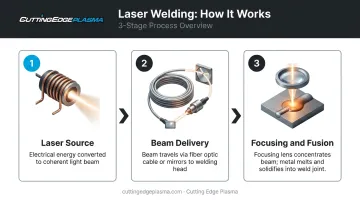
The process breaks into three stages, each handling a distinct conversion of energy:
- A laser source converts electrical energy into a coherent, collimated light beam
- The beam travels via fiber optic cable or mirrors to the welding head
- A focusing lens inside the welding head concentrates the beam onto the workpiece surface. The metal absorbs the energy, heats above its melting point, forms a molten pool, and solidifies into a weld joint on cooling
Conduction Mode vs. Keyhole Mode
The most important operational decision in laser welding is which mode to run.
| Mode | Power Density | Weld Profile | Best For |
|---|---|---|---|
| Conduction | Lower | Wider than deep, smooth surface | Thin materials, cosmetic welds |
| Keyhole | High | Deep and narrow, vapor cavity formed | Thick sections, structural joints |
In conduction mode, energy transfers through surface heating — similar in penetration shape to arc welding, but with a smaller heat-affected zone (HAZ). In keyhole mode, power density is high enough that metal vaporizes, creating a narrow vapor cavity (the "keyhole") that allows the beam to penetrate deep into the material rather than just melting the surface.
Both modes benefit from a critical physical advantage: the extreme temperatures laser welding reaches at the focal zone keep energy concentrated precisely where it's needed, limiting heat spread into surrounding metal.
Temperature and the HAZ Advantage
Laser welding generates extreme temperatures at the focal zone. In one peer-reviewed keyhole welding experiment, the keyhole plasma electron temperature reached 18,000 K (~17,727°C) at 800 W and 0.7 m/min. That figure applies to keyhole plasma specifically, not the bulk weld pool — it shows why the process can melt virtually any industrial metal.
For comparison, Lincoln Electric notes that an arc tip reaches approximately 6,500°F (~3,593°C). The concentrated delivery of laser energy — not just higher temperatures — is what keeps the surrounding material cool and the HAZ narrow.
Laser Welding Machine Components and Technology
Core Machine Components
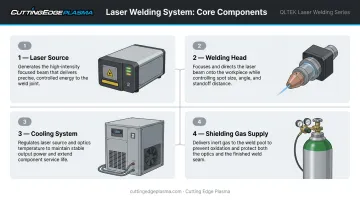
Every laser welding system, from a compact handheld unit to a full robotic cell, shares the same fundamental architecture:
- Laser source — The energy core. Determines power output, beam quality, and wavelength. Fiber lasers dominate modern systems, accounting for 45.5% of laser welding machine revenue in 2025
- Welding head — Houses the collimating and focusing lenses that shape the beam to the required spot size; some heads include an optional wire feeder for depositing filler material when bridging gaps or joining dissimilar metals
- Cooling system — Air-cooled units suit lower-power, intermittent applications; water-cooled systems handle higher duty cycles and sustained production use
- Shielding gas supply — Argon, helium, or mixtures protect the weld pool from oxidation and atmospheric contamination during welding; TWI notes process gases also shield the solidified bead
Laser Source Types
Three laser technologies appear in welding applications:
- Fiber lasers — Operate around 1,064–1,070 nm, high electrical efficiency, excellent beam quality, low maintenance, well-suited to metals. The clear modern standard for both handheld and industrial systems
- CO2 lasers — Longer wavelength (10.6 µm), better absorbed by some non-metals, but less common for metal fabrication today
- Nd:YAG lasers — Also operate around 1,064 nm, historically used in pulsed spot welding applications; largely replaced by fiber systems in new installations
Continuous Wave vs. Pulsed Operation
Output mode controls how heat enters the part:
- Continuous wave (CW) — Constant, uninterrupted beam output; ideal for long seams, high-speed production, and thick material welding
- Pulsed — Discrete energy bursts with lower average heat input; suited to thin materials, heat-sensitive assemblies, and precision spot welding where thermal control matters most
Handheld vs. Automated Systems
Volume and part complexity drive the decision between handheld and automated systems:
- Handheld laser welders — Portable, operator-guided, suited to repair work, custom fabrication, and small-batch production. They bring laser welding within reach of smaller shops that can't justify a full robotic cell
- Robotic/CNC-integrated systems — Deliver repeatable precision at high speed; the standard for automotive assembly, EV battery production, and high-volume production runs
What Materials Can Be Laser Welded?
Material properties — specifically melting point, thermal conductivity, and laser reflectivity — determine how straightforward or demanding a laser welding application will be.
Stainless Steel
The most common and straightforward material for fiber laser welding. Absorbs near-IR wavelengths well relative to aluminum or copper, produces clean, strong welds with minimal HAZ, and handles both thin sheet and heavier sections. IPG's LightWELD system, for example, lists stainless steel capability up to 0.313 inches on handheld units, while higher-power industrial fiber lasers have welded 1-inch 304 stainless at 20 kW.
Aluminum
Popular but more demanding. High reflectivity and thermal conductivity mean aluminum requires higher laser power or compensating techniques — wobble welding heads that widen the beam footprint are one common approach, improving process consistency and reducing porosity. IPG's system handles aluminum 3 and 5 series up to 0.325 inches and 6 series up to 0.229 inches.
Carbon Steel and Galvanized/Coated Steels
Generally weldable with proper parameter control. Galvanized steel introduces a specific challenge: zinc has a boiling point of just 906°C, well below steel's melting point, so it vaporizes during welding. Fume extraction or vacuum suction at the weld zone is the documented mitigation approach.
Copper
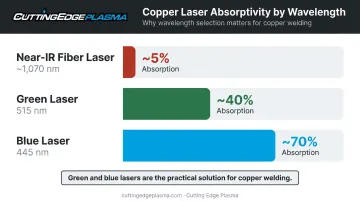
Copper is the most reflective common metal at near-IR wavelengths — Laserax reports absorptivity of roughly 5% for fiber lasers around 1,070 nm. Blue (445 nm) and green (515 nm) laser wavelengths improve absorption substantially: one peer-reviewed study recorded approximately 40% absorption at 515 nm. For most copper welding applications, green or blue laser sources are the practical answer.
Titanium
Titanium responds well to laser welding but requires strict inert gas shielding. TWI identifies oxygen, nitrogen, and hydrogen from entrained air as the primary contamination risks — any of which can cause embrittlement, cracking, or porosity in the finished weld.
Dissimilar Metals
Joining two different metals is possible but requires careful parameter balancing and often filler wire to manage differences in melting point, thermal expansion, and metallurgical compatibility. Common pairings like aluminum-to-steel or copper-to-stainless are achievable — each demands its own validated parameter set.
Advantages and Limitations of Laser Welding
Advantages
For fabricators, three benefits stand out:
- Precision and low distortion: Concentrated energy keeps the surrounding material cool, which matters on thin sheet metal, precision assemblies, and any part where warping is a rejection risk
- Speed: IPG states LightWELD handheld units run up to 4× faster than TIG on compatible materials; The Fabricator reported similar comparisons to MIG welding in the context of shop adoption
- Automation compatibility: No physical contact with the workpiece means clean integration with CNC motion systems and robotic arms
Beyond those three:
- Autogenous (filler-free) welds on well-fitted joints eliminate consumable cost
- Minimal spatter means less post-weld cleanup
- Suitable for geometries that contact welding processes can't reach
Limitations and Practical Considerations
Laser welding has real constraints that matter before any purchase decision:
- Upfront equipment cost is substantially higher than MIG or TIG setups — established 1,500 W handheld systems from IPG run $22,400 to $32,900 at current US dealer pricing
- Joint fit-up is critical: EWI's guidance puts the acceptable gap at no more than 10% of the thinnest part's thickness. Sloppy fixturing or inconsistent part prep directly causes weld failures
- Laser safety requirements: Operator training and appropriate PPE are mandatory, not optional. Handheld systems require particular attention to beam hazard protocols
Shops whose primary need is precision cutting — not joining — should also consider that laser welding and CNC plasma cutting serve different purposes. Cutting Edge Plasma's iPlasma XTREME series starts at $17,495 and is designed for accurate, repeatable sheet metal cutting, with a simpler safety footprint and lower fit-up sensitivity than laser welding systems.
Real-World Applications of Laser Welding
Automotive
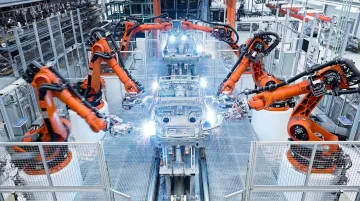
The largest application sector by far. The automotive laser welding system market was valued at $1.25 billion in 2024, with a projected CAGR above 4.8% through 2034. Mercedes-Benz S-Class body-in-white assembly uses 14 meters of laser weld seams per vehicle. Volkswagen has incorporated laser welding across the Audi A6 and A4.
EV battery production is another high-growth application. TRUMPF's systems handle battery pack assembly components where joint tightness and crash safety are strictly enforced by safety regulations:
- Busbars and soft connectors
- Can-caps and module housings
- Structural seams requiring hermetic seals
Aerospace and Medical Devices
Both industries depend on laser welding's small HAZ and ability to handle exotic alloys without contamination. Aerospace applications center on titanium and nickel-based alloy components, where any contamination during welding can cause structural failures.
Medical device manufacturing relies on it for hermetic sealing of titanium housings. Pacemakers, neurostimulators, and Class III implantable devices all require watertight, contamination-free enclosures — and laser welding consistently meets those standards.
Smaller-Scale Fabrication
Handheld laser welders have opened the technology to metal furniture manufacturing, sheet metal enclosures, pipe and tube joining, and even jewelry production. The Fabricator documented the shift as early as 2022, noting adoption spreading beyond large factories into smaller production environments where speed over MIG and the cleaner finish outweigh the higher equipment cost.
Frequently Asked Questions
How hot do laser welders get?
In keyhole mode, one peer-reviewed study measured keyhole plasma electron temperature at 18,000 K (~17,727°C) at 800 W — that applies to the plasma inside the keyhole, not the general weld pool. Conduction mode operates at lower intensities, and no single verified temperature range applies universally across all modes and power levels.
How much does a 1,500-watt laser welder cost?
Established 1,500 W handheld systems carry real price tags. IPG's LightWELD 1500 lists at $22,400 through US dealers; the LightWELD 1500 XR lists at $32,900. Lower-cost import units exist at significantly lower prices, but performance, support, and longevity vary considerably.
What is the difference between laser welding and TIG welding?
TIG uses an electrical arc and demands more operator skill, produces a larger HAZ, and runs slower on thin materials. Laser welding is faster, produces a smaller HAZ, and integrates cleanly with automation. TIG handles larger joint gaps more forgivingly and carries a much lower equipment entry cost, which matters for shops that don't weld at high volume.
What materials can be laser welded?
Stainless steel, carbon steel, mild steel, aluminum, and titanium are the most common. Some copper alloys are weldable with green or blue laser sources. Reflectivity and thermal conductivity are the main variables that determine difficulty and required parameters for each material.
Is laser welding suitable for hobbyists or small shops?
Entry-level handheld units have made it more accessible, but the equipment cost, laser safety requirements, and fit-up precision demands make it best suited to serious hobbyists and small shops with consistent, repeatable welding needs. It's not a practical choice for occasional or light-duty use.
What are the two main modes of laser welding?
Conduction mode uses lower power density to produce shallow, wide welds with smooth surfaces — suited to thin materials and cosmetic applications. Keyhole mode uses high power density to vaporize metal and drive the beam deep into the workpiece, creating narrow, deep welds for structural and thicker-section applications.