Introduction
Laser welding has moved well beyond the Tier 1 OEM shop floor. Fabricators, job shops, and small manufacturers are adopting it now — because the economics finally make sense and the applications are multiplying fast.
The pressure driving this change is real. Lightweighting mandates, the surge in EV production, and increasingly complex vehicle architectures have created demand for joining methods that MIG and TIG simply can't meet at the required speed, precision, and scale. Laser welding fills that gap.
Knowing laser welding matters is the easy part. Entering the space profitably is where most fabricators get stuck: Which applications should they target first? Which laser technology fits their work? What mistakes drain budgets before production even starts?
This article answers those questions directly — covering the highest-value automotive applications, how to choose the right laser technology, the defect risks that catch shops off guard, and the workflow decisions that separate shops that succeed in automotive laser welding from those that stall out.
Key Takeaways
- EV manufacturing is the fastest-growing demand source for laser welding, driven by battery and motor stator joining requirements
- Fiber lasers dominate most automotive applications due to efficiency, low maintenance, and robot integration
- Poor part fit-up and zinc coating gaps are the two most common defect sources in production
- Upstream cut quality directly determines weld outcomes — precision cutting reduces downstream rework
- Validate your process before committing to fixturing — it's the highest-ROI step most shops skip
Why Automotive Laser Welding Is a Growing Opportunity
The automotive industry's material mix has changed dramatically. High-strength steels, aluminum alloys, and multi-material assemblies now appear across body structures, powertrains, and battery enclosures. Traditional resistance spot welding and MIG/TIG struggle to handle these materials efficiently — especially at the joint geometries and cycle times modern vehicle platforms demand.
Electric vehicles have sharpened this pressure considerably. According to the IEA's Global EV Outlook 2025, global electric car sales reached nearly 14 million in 2023 and exceeded 17 million in 2024, with sales expected to surpass 20 million in 2025 — representing more than one quarter of all global car sales. By 2030, the IEA projects the global EV fleet could reach 250 million vehicles.
Every one of those vehicles needs battery packs, electric motors, and power electronics joined with precision laser welds — at volumes and tolerances that MIG or resistance welding can't reliably hit.
What This Means for Fabricators
The production numbers make the opportunity concrete:
- EV battery modules require hundreds of individual precision welds per module
- Electric motor stators use 160 to 220 laser-welded hairpin connections per unit — some designs reach 300
- These are repeatable, high-volume applications with tight tolerances that rule out manual welding
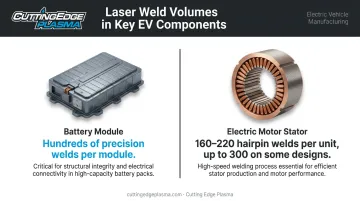
That combination of volume, repeatability, and precision is exactly where laser welding earns its place on the shop floor.
Fiber laser technology has also made entry more realistic. Compared to older lamp-pumped Nd:YAG systems, modern fiber lasers achieve wall-plug efficiencies of 20–30% versus 3–5% for lamp-pumped systems, with maintenance intervals measured in tens of thousands of hours rather than hundreds. For smaller fabrication shops, that translates directly to lower per-weld cost and faster payback on the equipment investment.
Core Automotive Laser Welding Applications
Body-in-White (BIW) Welding
Body-in-white — the car's structural frame before paint or final assembly — is one of the largest laser welding application segments. According to Global Market Insights, the BIW segment held roughly 30% of the automotive laser welding system market in 2024 and is projected to reach $575.5 million by 2034.
Laser welding displaced resistance spot welding in BIW because it offers:
- Single-sided joint access (no opposing electrode required)
- Narrower flanges, reducing vehicle weight
- Higher torsional stiffness in finished assemblies
- Lower thermal distortion on visible exterior panels
Historical production data illustrates the scale: the VW Golf V used 70 meters of laser-welded seams in its body structure, compared to just 1.4 meters on the preceding Golf IV — a 50× increase driven entirely by quality and efficiency gains.
Tailored Blank Welding
Laser-welded tailored blanks join steel sheets of different thicknesses or grades before stamping. The result is a single pressed part that concentrates material where structural loads demand it — without adding unnecessary weight elsewhere.
ArcelorMittal has documented that nesting optimization in tailored blank production reduced material usage by nearly 30% and cut costs by approximately €1.00 per car (roughly $1.10). At high volumes, those numbers add up fast. For fabricators supplying stamping operations, tailored blank capability creates a direct path into structural automotive supply chains.
Powertrain and Component Welding
Laser welding handles precision components that can't tolerate post-weld rework:
- Transmission gears and planetary carriers
- Fuel injector bodies and solenoid housings
- Airbag initiators and actuator assemblies
- Torque converter components
Pre-machined parts go in, finished assemblies come out — with heat-affected zones narrow enough to preserve the dimensional tolerances machined before welding.
EV-Specific Applications
As electrification scales up, two applications have emerged as the most technically demanding in automotive laser welding today: battery tab welding and copper hairpin welding for motor stators.
Battery tab welding connects cell terminals to busbars across a module. IPG's production battery welding systems achieve speeds up to 15 cylindrical cells per second with position accuracy of ±50 µm — specifications that define the process window for EV production.
Copper hairpin welding presents a different challenge. Each stator requires 160–220 welds on individual conductors, and copper's high infrared reflectivity makes standard fiber lasers inefficient for the job. Green or blue wavelength lasers address this directly, delivering dramatically better copper absorption and consistent weld quality at volume.
Choosing the Right Laser Technology for Automotive Work
Fiber Lasers as the Default Starting Point
Fiber lasers dominate automotive welding for practical reasons:
- High electrical efficiency (20–30% wall-plug)
- Beam delivery via flexible fiber optic cable — critical for robot integration
- No consumables, minimal scheduled maintenance
- Scalable power from hundreds of watts to multiple kilowatts
- 100,000+ hour maintenance intervals versus ~1,000 hours for lamp-pumped Nd:YAG
Pulsed Nd:YAG systems still appear in small spot weld and mold repair applications, but fiber lasers have displaced them in most production environments.
Conduction vs. Keyhole Mode
Once you've selected a fiber laser, how you configure it determines the weld you get. Two fundamentally different weld pool behaviors emerge depending on power density:
- Conduction welding — lower power density, shallow rounded bead, minimal spatter. Best for thin sheet, cosmetically visible joints, and electronics housings
- Keyhole welding — high power density creates a vapor cavity that drives deep penetration at high speed. Best for structural components needing full fusion
Laser power, focal spot diameter, and travel speed together determine which mode is active — and matching that mode to the application is one of the most consequential process decisions a shop makes.
Advanced Beam Control: ARM and Wobbling
Two beam control techniques have opened up joints that were previously too difficult to weld consistently:
Adjustable Ring Mode (ARM) surrounds the primary laser spot with a controllable outer ring beam:
- Preheats the weld zone before the core beam arrives
- Stabilizes the melt pool and cuts spatter sharply
- Most effective on aluminum body panels and galvanized steel
Laser wobbling oscillates the beam in a controlled pattern across the weld zone:
- Purpose-built for dissimilar metal joints (aluminum tabs to nickel-plated steel battery cans, for example)
- Manages mismatched melting points and thermal conductivities
- Research supports reduced porosity and improved microstructure in aluminum welds
Wavelength-Material Matching for Copper
Standard 1064 nm infrared fiber lasers couple poorly into copper — the material's high reflectivity wastes most of the delivered energy. Two alternatives perform significantly better:
| Laser Type | Wavelength | Copper Absorption |
|---|---|---|
| Standard fiber (Nd:YAG) | ~1064 nm | Low (~5% at room temperature) |
| Green disk laser (e.g., TRUMPF TruDisk) | 515 nm | ~8× higher than infrared |
| Blue diode laser (e.g., Laserline) | 445 nm | ~70% |
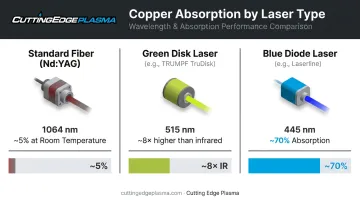
For copper hairpin welding in EV motors, green or blue wavelength lasers are the practical solution. That absorption advantage means stable melt pools, lower spatter, and consistent joint quality.
Common Challenges and How to Overcome Them
Zinc Coating in Galvanized Steel BIW
Galvanized steel's zinc coating vaporizes at roughly 906°C — far below steel's melting point of ~1500°C. When two galvanized sheets are clamped tightly together in a lap joint, zinc vapor gets trapped at the interface and causes porosity, blowholes, and expulsion.
Two production-proven solutions:
- Controlled interface gap — Research published in the Journal of Laser Applications identifies a gap of 0.1 to 0.2 mm between lapped surfaces as sufficient to allow zinc vapor to escape without compromising fusion
- Laser dimpling — Pre-stamping shallow dimples into one sheet before assembly creates a consistent gap without requiring precise clamping gap control during welding
Fit-Up and Part Tolerance
Laser welding has a narrow process window for gap tolerance. For butt joints, allowable gaps are typically less than half the beam diameter, which means tight dimensional control on every upstream process.
Fixturing quality, clamping systems, and edge condition all matter. Shops that achieve the best fit-up results invest as seriously in upstream blank quality as in the laser system itself.
Laser Safety Requirements
Laser welding generates hazardous reflections and weld fumes. OSHA categorizes most industrial laser welding systems as Class 1 enclosures — meaning a higher-class laser source operates inside a properly interlocked, labeled protective enclosure.
For shops retrofitting laser welding into existing lines, newer enclosed process head designs can achieve Class 1 classification at the weld zone without requiring a full production booth. These designs clamp around the joint area and provide local fume extraction — saving floor space while meeting safety requirements under ANSI Z136.1 and IEC 60825-1.
Porosity in Aluminum Welding
Aluminum presents multiple challenges simultaneously: high reflectivity at infrared wavelengths, a low-viscosity melt pool, and susceptibility to hot cracking in certain alloys. Keyhole instability is the primary mechanism behind porosity.
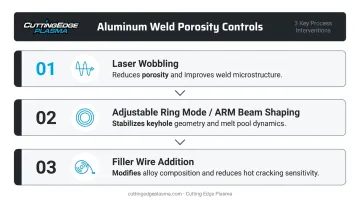
Effective controls include:
- Laser wobbling — reduces porosity and improves microstructure in aluminum welds
- Adjustable Ring Mode (ARM) beam shaping — stabilizes the keyhole and melt pool
- Filler wire addition — modifies alloy composition to reduce hot cracking sensitivity
Best Practices to Get Ahead in Automotive Laser Welding
Validate Before You Fix and Automate
The most expensive mistake in laser welding is committing to fixturing and automated motion systems before the process is validated. Run feasibility studies with representative materials, real joint configurations, and the actual production laser. Major laser suppliers including IPG and TRUMPF operate application development labs specifically for this purpose — use them before signing off on production tooling.
Time spent in process development upfront compounds favorably. Defects caught at the application stage cost engineering hours. Defects caught in production cost rework, scrap, and customer relationships.
Build a Precision-First Workflow
Once the process is validated, the laser system itself is only one part of the quality equation. Part fit-up — determined entirely by upstream processes — controls whether the weld is achievable at all.
Fabricators serious about automotive laser welding pair their laser with upstream cutting equipment capable of consistent, clean edges. For structural blanks and larger components, CNC plasma cutting is a practical entry point: machines from Cutting Edge Plasma give fabricators a cost-effective way to produce dimensionally consistent blanks that feed cleanly into a downstream welding operation.
For tighter tolerance applications, QLTEK fiber laser cutting machines achieve the edge quality needed for more demanding butt-joint configurations. Shops that compete effectively in laser welding treat cut, fit, and weld as a single connected system — not three separate steps.
Automate and Trace from Day One
In automotive supply chains, weld traceability isn't optional — it's expected. Inline process monitoring systems from suppliers like Precitec use AI-supported analysis to evaluate welds in real time and generate the quality documentation automotive customers require.
Plan integration from the initial equipment selection — not as a retrofit. Specifying the following upfront is far easier than engineering around an existing standalone machine:
- Robotic motion interfaces and communication protocols
- CNC control compatibility with your production environment
- Monitoring system outputs and data logging for customer documentation
Frequently Asked Questions
What are the most common laser welding applications in automotive manufacturing?
The main categories are body-in-white assembly (roof panels, door frames, chassis sections), tailored blank welding for stamped structural parts, powertrain components (transmission gears, airbag initiators, fuel injectors), and EV-specific applications including battery tab welding and copper hairpin welding for electric motor stators.
How does laser welding compare to MIG or TIG welding for automotive parts?
Laser welding delivers a smaller heat-affected zone, faster cycle times, less thermal distortion, and far greater automation potential than MIG or TIG. The trade-offs are a higher initial equipment cost and tighter requirements for part fit-up and edge quality before welding.
What is body-in-white welding and why is laser preferred for it?
Body-in-white refers to a vehicle's structural frame before paint or final assembly. Laser welding is preferred for single-sided joint access, narrower flanges (reducing weight), higher torsional stiffness, and production speeds that resistance spot welding cannot match.
Can small fabrication shops realistically adopt automotive laser welding?
Yes — particularly for components and subassembly work. Handheld fiber laser welding machines and compact integrated laser welding systems have brought the technology within reach for small and mid-size shops, even if industrial-scale BIW production remains a large-capital proposition.
Why is copper hairpin welding considered one of the hardest laser welding challenges?
Copper's high infrared reflectivity means standard fiber lasers couple poorly into the material, making stable melt pool formation difficult. Achieving the consistent, high-strength joints required for electric motor performance requires either green or blue wavelength lasers — which offer far higher copper absorption — along with precise power management.
How does the shift to EVs impact demand for automotive laser welding?
EV manufacturing has expanded laser welding demand across multiple fronts at once: battery packs require hundreds of precision tab welds per module, while electric motors depend on 160–220 laser-welded hairpin connections per stator — both well-suited to laser welding's precision and throughput.