Introduction
If you've ever had a powder coat peel off a freshly cut part or watched a weld crack under load, laser oxide may be the culprit you overlooked. It's a thin, shiny film — grey-blue or iridescent — that forms along cut edges whenever a CO2 laser or plasma cutter uses oxygen as an assist gas. Left untreated, it blocks coating adhesion and contaminates weld zones before the part ever reaches finishing.
According to TIGER Drylac's powder coating troubleshooting guide, the finding is direct: "No adhesion on laser-cut edges due to oxide film." Similarly, TWI states that weld surfaces must be clean and free from scale and heavy oxide coatings before any joining operation.
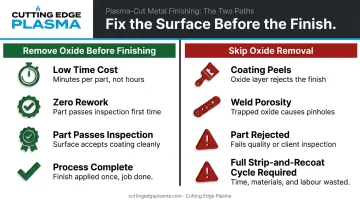
That means skipping oxide removal leads directly to peeling coatings, weld porosity, scrapped parts, and rework cycles that eat into margins fast.
This guide covers what laser oxide is, why it forms, every major removal method with honest trade-offs, and best practices to build into your workflow.
Key Takeaways
- Laser oxide is a thin iron oxide film that forms on cut edges when oxygen assist gas is used during CO2 laser or plasma cutting
- It prevents proper weld fusion and blocks paint and powder coat adhesion
- Five removal methods exist, each suited to different volumes and part geometries
- Visual inspection after removal is required before any finishing step
- Treating parts promptly after cutting is the single most effective way to prevent stubborn oxide buildup
What Is Laser Oxide and How Does It Form?
Laser oxide — sometimes called oxide skin or laser scale — is a thin film that appears around cut edges on metal parts after oxygen-assisted thermal cutting. On mild steel, it looks like a shiny, grey-blue, or iridescent band running along the contour of every cut.
The Chemistry Behind It
When oxygen is used as an assist gas during CO2 laser cutting, it does two things at once:
- Fuels an exothermic reaction with the hot metal, accelerating the cut
- Oxidizes the cut surface as iron reacts with oxygen to form iron oxide compounds — primarily FeO and Fe₃O₄
A peer-reviewed study in IOP Science identifies this iron-to-FeO oxidation reaction as central to laser-oxygen cutting of mild steel. The result is a chemically distinct layer on the cut edge — not mill scale, not weld heat tint, but a post-cut oxide specific to oxygen-assisted thermal cutting.
Which Metals Are Affected
| Metal | Oxide Appearance | Severity |
|---|---|---|
| Mild/carbon steel | Shiny grey-blue or iridescent film | Most heavily affected |
| Stainless steel | Different oxide chemistry (magnetite + chromium-doped phases) | Significant — chemistry differs from mild steel |
| Aluminum | Rough, heavily oxidized black surface (air plasma) | Present; appearance varies |
Plasma Cutting Creates the Same Problem
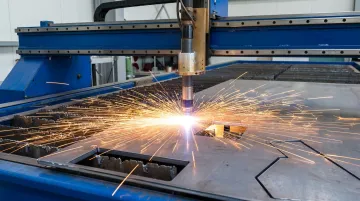
The metal type matters, but so does the cutting process. Plasma cutting with oxygen assist gas produces the same oxide layer through the same mechanism — oxygen reacting exothermically with iron in liquid metal. For shops running CNC plasma tables, this means every oxygen-plasma-cut mild steel part carries the same pre-treatment requirement as a laser-cut part before welding or coating. Air plasma systems (like the Hypertherm Powermax series) produce less severe oxidation, but cut edges on mild steel still require inspection before finishing.
Why Laser Oxide Must Be Removed Before Welding or Coating
The oxide layer creates two distinct failure modes — one at the weld joint, one at the coating surface. Both are preventable.
Weld Failures
Oxide doesn't bond to the base metal permanently — it sits on the surface as a brittle, flaking film. When you weld over it, the oxide acts as a barrier that prevents proper metal fusion at the joint.
The consequences:
- Weld porosity from nitriding and oxidation on the cut surface
- Reduced joint strength that may not appear until the part is under load
- Potential weld failure under stress — a safety issue, not just a quality issue
TWI's surface preparation guidance requires that surfaces around the weld joint be clean and free from scale and heavy oxide coatings. That's not a suggestion — in many industries, it's a baseline quality requirement written into welding procedure specifications.
Coating Failures
PCI Magazine's analysis of laser-cut carbon steel explains the failure mechanism clearly: powder coating does adhere to the oxide film — but the oxide isn't permanently attached to the steel underneath. So the coating bonds to something that itself can't hold on. The result is peeling and blistering at cut edges, often appearing shortly after the part enters service.
Standard phosphate pretreatments don't solve this. Phosphate chemistry can't penetrate the oxide layer, so running parts through a standard pretreatment line without removing oxide first still produces adhesion failures.
Quality and Compliance
Both failure modes above share the same downstream consequence: parts that reach a customer or inspection stage with oxide-related defects get rejected. Automotive, aerospace, and structural fabrication applications treat oxide-free surfaces as a minimum entry requirement before any finishing step. Skipping removal doesn't save time — it shifts the cost to incoming inspection, where the fabricator loses the time and material already invested.
Oxide removal takes minutes per part with the right equipment. Rework — recoating, rewelding, or scrapping a finished assembly — costs multiples of that in labor, material, and schedule. Fix the surface before the finish, not after.
Laser Oxide Removal Methods: A Comparison
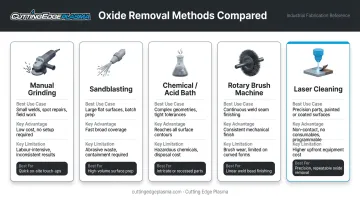
No single method works best in every situation. Part geometry, production volume, available equipment, and downstream requirements all influence the right choice. Each method below covers how it works, where it excels, and where it falls short.
Manual Scraping and Hand Grinding
Wire brushes, flap discs, or angle grinders remove the oxide layer by mechanical abrasion at the cut edge.
Trade-offs:
- Effective when done carefully, but consistency depends entirely on the operator
- High labor cost per part at any meaningful production volume
- Difficult on complex geometries — interior contours, tight holes, and intricate profiles are nearly impossible to reach consistently
- Best suited for prototypes, low-volume rework, or spot touch-up before a critical weld
It's a valid last resort — not a production strategy.
Sandblasting (Abrasive Blasting)
High-velocity abrasive media strips the oxide from exposed surfaces. AMPP confirms that abrasive blasting also creates a surface profile of peaks and valleys that increases coating bond strength — a secondary benefit worth noting for paint or powder coat applications.
Trade-offs:
- Strong on exterior surfaces and outside edges; struggles to reach internal features and complex contours
- Surface profile must be controlled — too little reduces adhesion, too much leaves peaks under-covered and can accelerate corrosion
- OSHA's abrasive blasting guidelines require employers to protect workers from hazardous dust and toxic metals generated by both the abrasive and the substrate
- Requires ventilation, respiratory protection, and proper media containment
Shops that need surface profile for coating adhesion — and already have blasting infrastructure — get the most out of this method.
Chemical / Acid Bath Treatment
Parts are submerged in hydrochloric acid or proprietary deoxidizing solutions that dissolve iron oxide chemically. The process reaches all surfaces — including interior contours and complex features that mechanical methods can't access.
Trade-offs:
- Effective on any geometry, including slots, holes, and tight internal radii
- Introduces significant hazmat requirements: storage, handling, neutralization, wastewater disposal
- Operators require PPE and training; EPA Metal Finishing Effluent Guidelines govern wastewater discharge
- Chemical cost is relatively low, but compliance overhead makes it impractical for smaller shops without existing acid-handling infrastructure
For shops already equipped to handle acids, this method solves geometry problems that no brush or blast can.
Rotary Brush Machines
Automated machines pass parts under rotating steel wire brush heads that contact both flat surfaces and cut-edge contours in a single pass. Timesavers describes their brush-based systems as a direct replacement for manual oxide removal — reaching the surface and sides of cut edges simultaneously.
Trade-offs:
- Consistent and repeatable versus manual methods
- Can process interior contours, holes, and cutouts in one pass on suitable machines
- Brush wear is real — wire brushes degrade over time and require monitoring and replacement
- Best suited for flat sheet metal parts at moderate-to-high production volumes
- Can be combined with deburring and edge rounding in the same pass, reducing total finishing steps
For shops running consistent flat-sheet volumes, rotary brush machines offer a strong balance of throughput, consistency, and operating cost.
Laser Cleaning
A pulsed laser beam ablates the oxide layer through thermal shock, vaporizing or peeling the unwanted material without contact, abrasive media, or chemicals. IPG Photonics describes the process as removing unwanted material without harming the substrate — pulse duration and power density need to be dialed in per material to avoid surface damage.
Trade-offs:
- Highly precise; no consumables, no chemical waste, no abrasive dust
- Excellent for high-value or precision parts where surface integrity is critical
- Capital cost is the barrier — industrial laser cleaning systems are a significant investment; verify current pricing directly with vendors
- Handheld systems exist for spot applications; industrial systems suit continuous production
Best for aerospace, medical, or precision fabrication applications where contamination or dimensional change from mechanical methods is unacceptable.
How to Tell If Laser Oxide Has Been Fully Removed
Skipping verification is what turns a $2 inspection into a $200 rework.
Visual Inspection Indicators
A fully cleaned part shows:
- Consistent matte metallic surface at all cut edges
- No grey-blue, iridescent, or scale-like film along any contour
- Uniform appearance across both outside edges and interior features
Any discoloration, sheen, or patchy areas along cut contours mean incomplete removal. Use a raking light angle to make residual oxide visible — flat overhead lighting misses the iridescent sheen that confirms oxide is still present.
Downstream Failure Signs
If oxide slips through inspection undetected, these are the failure modes that reveal it later:
- Paint or powder coat peeling at cut edges shortly after application
- Porosity or weak spots in welds adjacent to cut surfaces
- Failed pull-off adhesion tests (ASTM D4541) during coating validation
Each of these failures triggers a full strip-and-recoat or re-weld cycle — far costlier than 90 seconds of pre-release inspection.
Recommended Inspection Protocol
Build this into every removal pass:
- After treatment, move parts to a dedicated inspection area with adjustable lighting
- Use a raking light angle — hold a light source low and angled across the surface
- Check interior contours first — slots, holes, and cutouts are where mechanical methods most often leave residual oxide
- Any iridescent or grey-blue patches = return the part for additional treatment
- Document pass/fail before releasing to welding or coating
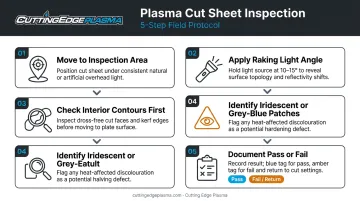
Logging pass/fail at this stage also builds a quality record that supports coating warranties and customer sign-off.
Best Practices for Laser Oxide Removal
Timing: Remove Oxide Before Anything Else
Oxide removal must happen after cutting and before every downstream step — welding, priming, painting, and powder coating all require a clean surface. Process parts promptly. Letting them queue on a rack without treatment makes the oxide harder to address and creates rework risk downstream.
Match Method to Part and Volume
| Scenario | Recommended Method |
|---|---|
| High-volume flat sheet parts | Rotary brush machine |
| Complex geometry with interior features | Chemical bath or laser cleaning |
| Low-volume, prototypes, spot rework | Manual grinding or wire brush |
| Profile requirement + exterior surfaces | Abrasive blasting |
| High-value or precision parts | Laser cleaning |
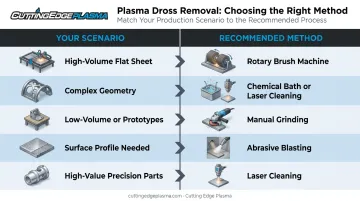
Test your chosen method on sample parts before committing it to a production run. What works on 3mm mild steel may not transfer directly to 6mm plate or stainless.
Safety Requirements by Method
- Chemical baths: PPE (acid-resistant gloves, face shield, apron), proper ventilation, neutralization before disposal, compliance with EPA Metal Finishing Effluent Guidelines
- Sandblasting: Respiratory protection, dust containment, media disposal — OSHA requirements apply to both abrasive dust and metal dust from the substrate
- Rotary brush machines: Metal dust extraction systems; OSHA combustible dust guidance covers aluminum and other metal dusts
- Laser cleaning: Appropriate laser safety eyewear, fume extraction for ablated material
None of these methods are hazard-free. Build safety controls into your process documentation before the first part runs — not after an incident forces the issue.
Write Removal Into Your Quality Documents
Verbal instructions drift over time. The most reliable shops write oxide removal into their work travelers and inspection checklists — specifying the method, the inspection criteria, and the sign-off requirement before a part can advance.
For application-specific documentation, reference the right standard for each process:
- Weld-critical parts: Cite TWI-style cleanliness language in your welding procedure specifications
- Coated parts: Reference your powder coat supplier's guidance on oxide-free surface requirements
Frequently Asked Questions
What is laser oxide and how does it form?
Laser oxide is a thin iron oxide film created when a CO2 laser or plasma cutter uses oxygen as an assist gas, triggering an exothermic reaction that oxidizes the metal along cut edges. It appears as a shiny grey-blue or iridescent film and must be removed before welding or coating.
Does plasma cutting create oxide the same way laser cutting does?
Yes. Plasma cutting with oxygen assist gas produces an equivalent iron oxide layer through the same mechanism — oxygen reacting with liquid iron at the cut edge. Oxide removal is equally important for plasma-cut parts before any welding or finishing operation.
Can laser oxide be removed without a machine?
Manual removal with wire brushes, flap discs, or angle grinders is possible but labor-intensive and inconsistent. It's only practical for very low volumes, simple geometries, or spot rework — not for repeat production where surface consistency matters.
Which metals are most affected by laser oxide?
Mild and carbon steel are most heavily affected. Stainless steel, aluminum, and copper also develop oxide layers, each with different appearance and chemistry. Stainless oxide includes chromium compounds not found in mild steel, so the right removal approach — parameters, passes, and technique — differs by material.
How much does a laser cleaning system cost?
Handheld laser cleaning units for spot applications typically start in the low tens of thousands of dollars. Industrial systems with higher continuous power output can reach six figures depending on wattage and configuration. Contact suppliers directly for current pricing on your specific application.
Is there a laser cleaner for cast iron?
Yes, but cast iron requires careful setup. Its porous structure and graphite content affect how it absorbs laser energy and traps ablated debris, so parameters need calibration and testing before committing to production use. The technology works — it just isn't plug-and-play on cast iron.