Introduction
Handheld laser welders have generated significant attention among fabricators, small shop owners, and hobbyists over the past few years — and the questions coming in are consistent: do they actually work, are they worth the money, and could one replace my TIG setup?
The honest answer is: it depends on what you're welding.
According to The Fabricator, handheld fiber laser welding has moved firmly into mainstream fabrication shops as a genuine productivity tool — not just a novelty. But the technology has real limitations that the marketing materials tend to gloss over.
This review covers how handheld laser welders work, where they genuinely shine, where they fall short, and who actually benefits from buying one — so you can make a confident decision before spending the money.
Key Takeaways
- Handheld laser welders deliver real speed advantages — IPG claims up to 4x faster than TIG on compatible material
- Performance depends heavily on joint fit-up, material cleanliness, and matching power level to thickness
- Entry-level units start around $3,000–$5,000; premium branded systems reach $38,000+
- Class 4 laser hazards require proper PPE, ventilation, and shielded work areas — all mandatory before running a single bead
- Shops focused on cutting rather than joining may find a CNC plasma table delivers better ROI per dollar
What Is a Handheld Laser Welder and How Does It Work?
A handheld laser welder is a portable fiber laser delivery system. The main unit houses the laser source; a fiber optic cable connects it to a gun-style welding head that the operator holds and guides along the joint. The laser beam concentrates intense energy at the weld point, melting two metal surfaces together without an external arc or open flame.
Most units ship on wheeled carts, making them mobile across a shop floor while keeping the heavy electronics off the operator's hands.
The Wobble Function
One feature that separates laser welding from older fixed-beam laser systems is beam oscillation, commonly called the wobble function. Instead of delivering a single focused point, the beam oscillates side-to-side as it travels — widening the effective weld zone and helping bridge small gaps in joint fit-up.
Wobble specs vary by manufacturer:
- IPG LightWELD: up to 0.2 inches of additional weld width with selectable oscillation frequencies
- Han's Laser: 0–5 mm (~0.2 inches) wobble range on handheld units
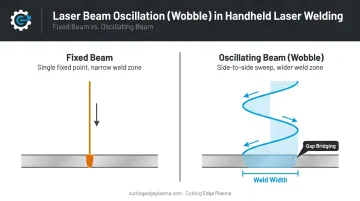
That gap-bridging capability is what makes handheld laser welding usable in real shop conditions — joints rarely arrive with perfect zero-gap fit-up.
Key Advantages of Handheld Laser Welders
Minimal Heat-Affected Zone and Weld Quality
The concentrated laser beam deposits energy in a very narrow area — a fundamental advantage over MIG or TIG. Less heat means less thermal distortion, reduced warping on thin material, and a weld that retains more of the base metal's structural properties.
A peer-reviewed study on 304 stainless steel welding found that laser-welded joints showed a fusion area of 6.7 mm² versus 13.9 mm² for TIG — and the HAZ visible in TIG joints was absent in the laser-welded samples. While that study used non-handheld equipment, it demonstrates the underlying physics that handheld systems also benefit from.
The practical result: weld beads that often need little to no post-weld grinding or polishing, saving real time on every finished part.
Speed and Productivity Gains
IPG states that LightWELD is up to 4x faster than TIG welding. That's a manufacturer claim, not an independently verified universal benchmark — but it's directionally consistent with what fabricators report when switching from TIG on thin sheet metal.
Faster cycle times translate directly to:
- Higher output volume per shift
- Shorter production turnaround
- Lower per-part labor cost on high-run jobs
For a shop running dozens of repetitive thin-metal welds daily, that speed gap compounds fast.
Portability and Flexibility
The handheld design lets operators work in tight spaces, awkward angles, and hard-to-reach positions that fixed or robotic systems can't reach. Most units sit on wheeled carts, so the machine moves around the shop rather than the workpiece moving to the machine.
Low Consumable Cost and Maintenance
Beyond speed, the cost-per-weld picture is favorable. For tight joints (gaps under roughly 0.2mm), laser welding typically skips filler wire entirely — a direct consumable savings over MIG. Compared to arc-based systems, handheld laser welders also require:
- No electrode replacements
- Minimal spatter cleanup between passes
- No torch rebuild intervals
Ease of Training
TIG welding demands significant dexterity and practice to produce consistent results. Laser welding has a shorter learning curve — many machines come with pre-set parameters for common material and thickness combinations, letting less experienced operators produce quality welds faster.
Handheld Laser Welders vs. Traditional Welding Methods
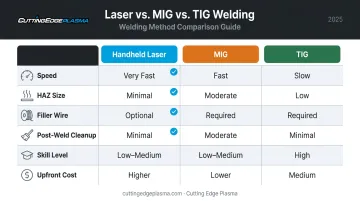
Laser vs. MIG vs. TIG — Quick Comparison
| Factor | Handheld Laser | MIG | TIG |
|---|---|---|---|
| Speed | Up to 4x faster than TIG (IPG claim) | Fast; suited to high-volume work | Slower; precision-oriented |
| HAZ Size | Small; minimal distortion | Larger than laser | Larger than laser |
| Filler Wire | Not required for tight joints | Required (auto-fed) | Optional; typically manual |
| Post-Weld Cleanup | Minimal soot/discoloration | More spatter; more cleanup | Clean bead; minimal spatter |
| Skill Level | Shorter learning curve | Easiest to learn | Highest skill requirement |
| Upfront Cost | $3,000–$38,900+ | Lower than TIG | Moderate to high |
Where Each Method Fits
Choose MIG when you're working with thicker material, rougher fit-up, or high-deposition jobs where aesthetics matter less than speed and cost.
Choose TIG for applications where weld quality is non-negotiable — aerospace, medical, and structural work with strict certification and joint integrity requirements. Its qualification standards are well-established across industries, which matters when traceability counts.
Choose laser when you're running thin to medium gauge material and need clean aesthetics with minimal post-processing. The upfront cost is higher, but volume production makes it pencil out quickly.
If weld integrity is your concern, the data on laser supports the "clean aesthetics" case more deeply than surface appearance alone. Research on fiber laser welded 304 stainless found tensile strength reaching 677–689 MPa — exceeding 95% of base metal strength. Laser-welded stainless joints can match or exceed TIG on compatible material. That said, handheld system performance depends on fit-up, parameters, and operator setup — results aren't automatic.
What Can Handheld Laser Welders Actually Weld?
Compatible Materials
Handheld fiber laser welders handle a wide material range:
- Stainless steel
- Carbon and mild steel
- Galvanized steel
- Aluminum
- Copper and brass
- Titanium
- Nickel alloys
- Some dissimilar metal combinations
That range — particularly dissimilar metals and reactive alloys like titanium — is where laser welding separates itself from arc processes, which often require filler rod changes, preheat, or post-weld treatment for the same materials.
Thickness Capabilities by Power Level
Published manufacturer maximums for common metals:
| Power Level | Stainless Steel | Carbon Steel | Source |
|---|---|---|---|
| 1,000W | ~4mm (0.156 in) | ~4mm (0.156 in) | IPG LightWELD |
| 1,500W | ~3.5–6mm (0.138–0.234 in) | ~3.5–6mm (0.138–0.234 in) | IPG / Han's Laser |
| 2,000W | ~4–8mm (0.156–0.313 in) | ~4–8mm (0.156–0.313 in) | IPG / Han's Laser |
| 3,000W | Up to ~6mm+ (0.234 in+) | Up to ~6mm+ (0.234 in+) | HANTENCNC |
These are published maximums under ideal conditions — not guaranteed shop outcomes. Real-world penetration depth depends on joint fit-up, surface cleanliness, and operator technique — any one of those variables can pull results well short of the spec sheet.
Where Laser Welding Works — and Where It Doesn't
| Works Well | Less Suitable |
|---|---|
| Thin to medium gauge sheet metal and tubing | Thick plate (arc welding offers more practical penetration) |
| Clean, tight-fit joints with minimal gap | Heavily corroded, coated, or scaled surfaces |
| Applications needing low distortion and clean aesthetics | Large gaps where MIG or TIG handles fit-up variation more forgivingly |
Honest Limitations of Handheld Laser Welders
Upfront Cost
Prices for handheld laser welders vary significantly based on power, cooling systems, and brand:
| System Tier | Typical Price Range |
|---|---|
| Entry-Level Air-Cooled (1-1.5kW) | $4,000–$7,000 |
| Mid-Range Water-Cooled (1.5-3kW) | $7,000–$15,000 |
| Premium Branded (e.g., IPG LightWELD) | $30,000+ |
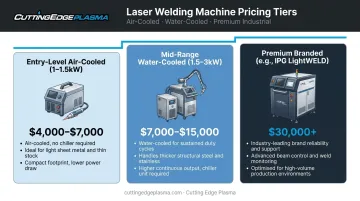
For a small shop or hobbyist, even the entry-level cost is a real capital commitment. For premium branded systems, the investment requires clear, high-volume justification to achieve meaningful ROI.
Joint Preparation Requirements
Laser welding is less forgiving than MIG on surface condition and fit-up. Mill scale, contamination, coatings, and gaps that MIG handles with minimal consequence will directly compromise laser weld quality. Consistent joint prep isn't optional — it's part of the process.
Safety Requirements
Handheld laser welders are Class 4 laser devices operating at roughly 1070nm infrared. This classification means:
- The beam is hazardous under any viewing condition
- Laser-rated eye protection is mandatory (OD 6+ at 1070nm minimum)
- Enclosed or shielded work areas are required
- Effective fume extraction is non-negotiable — welding fumes contain harmful metal particulates regardless of the heat source
These safety requirements add to the total setup cost and must be factored into the real purchase decision.
What to Look for When Choosing a Handheld Laser Welder
Power Output
Match power to actual material needs. Most fabrication shops working with sheet metal and thin-wall tubing will find 1,500W–2,000W sufficient. Watch for peak vs. continuous power ratings — published peak numbers can overstate what the machine sustains in real use.
Cooling System
Two cooling configurations dominate the market:
- Air-cooled: Lighter, more portable, lower maintenance. IPG's proprietary air-cooled design supports 100% duty cycle up to 2,000W.
- Water-cooled: Better suited for sustained high-power operation. Han's Laser and HANTENCNC publish water-cooled systems at 3,000W.
For intermittent shop use, air-cooled handles most jobs. High-volume production environments typically warrant water-cooled.
Is Welding Actually Your Primary Need?
If your shop's main bottleneck is metal cutting rather than joining, a CNC plasma table may deliver better ROI per dollar. Cutting Edge Plasma's iPlasma XTREME series starts at $17,495 and cuts steel, stainless, and aluminum across a full range of material thicknesses — with CNC repeatability that a handheld welder simply doesn't address. For shops that cut far more than they weld, the plasma table typically pays back faster.
Frequently Asked Questions
Do handheld laser welding machines actually work?
Yes — they deliver genuine advantages in speed, precision, and weld cleanliness on compatible materials. Performance depends on material prep, power level, and operator technique, but these are not novelty tools. They're in active production use across fabrication shops worldwide.
How thick of metal can handheld laser welding machines weld?
Standard 1kW–2kW handheld models typically weld 0.5mm to 6mm on steel under manufacturer-specified conditions. Higher-power 3kW units can push further, though real-world penetration varies by material type, joint quality, and surface condition.
What are the best handheld laser welding machine brands?
IPG Photonics (LightWELD), Han's Laser, and Raycus are the most commonly referenced names, each with different strengths across price points and product lines. The right choice depends on your budget, support availability in the US, and specific application requirements.
Are handheld laser welders safe to use?
They are safe when proper precautions are followed. As Class 4 laser devices, they require laser-rated eye protection (OD 6+ at 1070nm), a shielded or enclosed work area, and effective fume extraction. Skipping any of these steps creates serious hazards, not manageable risks.
Are handheld laser welders worth the cost for small shops?
ROI depends on weld volume and application. High-volume shops processing thin sheet metal will see faster payback through speed gains and reduced post-processing time. Low-volume shops or those primarily working with thick plate will typically find traditional MIG or TIG more economical.